Who will supply compute to consumers?
The compute debate is all about companies and data centres. But once households run multiple AI agents, demand shifts to hundreds of millions of homes.
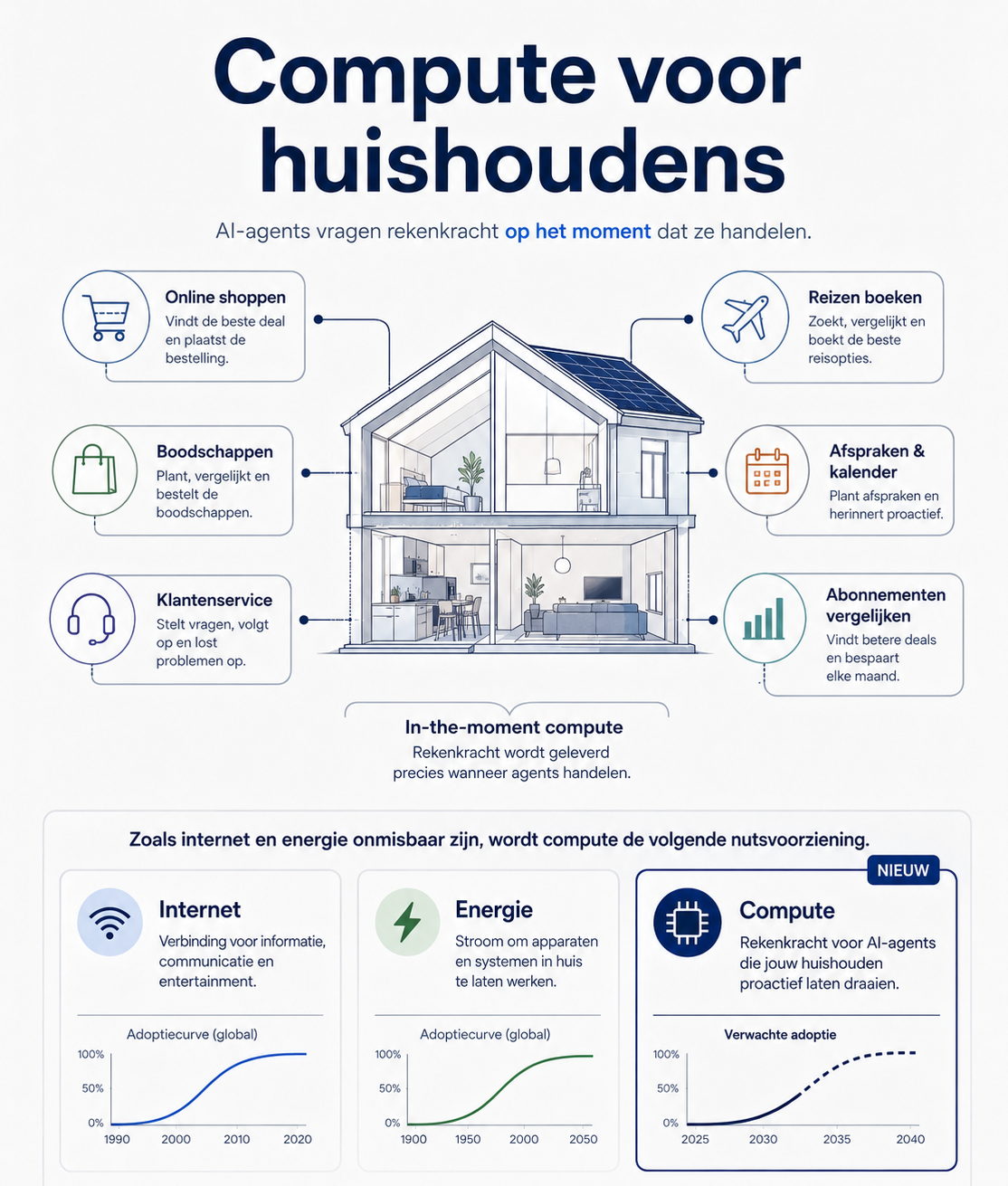
We almost always discuss compute in a corporate context: data centres, chips, AI models and how much capacity organisations need to work with artificial intelligence. That makes sense, because companies are investing in AI at scale and demand for compute is growing fast. Yet one party is strikingly absent from that discussion: the consumer.
Compute is the fuel behind AI
Compute is essentially the capacity needed to let software, AI models and agents perform tasks. Think of it as the fuel behind artificial intelligence. A language model generating an answer, an agent comparing information, a system carrying out a task on its own: all of it costs compute. So far consumers barely notice. You open ChatGPT, Claude or another AI application, perhaps pay a subscription, and the required compute is arranged in the background. To the user it simply looks like part of the service.
I think that picture will change as soon as agents start playing a much bigger role in everyday consumer life. Within a few years I expect households to use several personal agents that take over all sorts of practical tasks: ordering groceries, comparing prices, booking travel, changing subscriptions, managing appointments, contacting customer service or buying products. Today's internet still assumes that we open websites and apps ourselves, search for information, compare options and finally act. On an agentic internet, much of that work shifts to software acting on our behalf.
An agent does not just answer, it acts
That is a fundamental difference. An agent does not only answer a question, it actually takes action. It can check a grocery list, compare offers, take dietary preferences into account and then place an order automatically. Another agent can manage a family calendar, combine sports and school commitments and propose solutions to conflicts. Yet another can approach an energy supplier, insurer or telecom provider and negotiate a better deal.
Every time such an agent does something, compute is needed at that very moment. I call this in-the-moment compute. It is not only about the enormous amount of compute once required to train a model, but about the compute continuously needed when millions of agents perform tasks simultaneously. If your agent optimises your calendar on Monday morning, orders groceries at noon and compares three insurance policies that afternoon, each of those actions consumes compute again. Once households run several agents in parallel, that demand adds up quickly.
Compute as a utility
That is why I believe compute will increasingly resemble a utility. A household today needs energy to run appliances and internet to connect to digital services. In a world where agents handle a large share of our digital activity, a structural need for compute appears alongside them. Not occasionally, but continuously.
Right now that compute is delivered indirectly. When you pay for an AI service, the capacity is usually baked into the price. That model works as long as consumers use a limited number of applications. But what happens when someone has twenty different agents? A shopping agent, a travel agent, a financial agent, a personal assistant, a health agent, a household agent and perhaps agents that collaborate with each other? Does it still make sense for every provider to supply and bill its own compute separately?
I doubt that is the most efficient form. When you buy a vacuum cleaner you do not buy a separate energy contract with it. The manufacturer supplies the device; you arrange the electricity. Internet works the same way. We do not pay for a separate connection per website; we have one connection that gives access to thousands of digital services.
A compute subscription for households
So it is quite conceivable that something like a household compute subscription will emerge. A consumer buys or rents a certain amount of compute that different agents are allowed to use. Perhaps in bundles, like mobile data. Perhaps you pay for a guaranteed level of capacity, comparable to a broadband plan. Or perhaps a dynamic model appears where you pay more when your agents run many tasks at once.
That raises interesting questions. Who will supply that compute? The large cloud companies already operating data centres? Will telecom providers bundle compute with internet? Will new companies emerge focused specifically on consumer compute? Or will AI platforms themselves become the providers of that infrastructure layer?
The location of that compute is interesting too. Part of it can run in large data centres, but another part may happen locally at home, on phones, laptops or dedicated devices. A hybrid model is likely, with simple tasks handled locally and heavy tasks sent to the cloud. For consumers it may ultimately matter little where the calculation happens, as long as their agents act fast, reliably and affordably.
Compute then shifts from something technical and invisible to something economically relevant for households. Just as we ask today how much energy we use or what internet speed we need, we may soon ask how much compute our digital household requires.
Once agents become mainstream among consumers, demand for compute can move from thousands of companies to hundreds of millions of households.
The compute debate today is mostly about enterprises, AI labs and data centres. Rightly so, but it may make us overlook the next big market. The key question is then not only how much compute companies need, but also: who will supply the compute that lets consumers run their agents?


Job van den Berg is an AI keynote speaker, tech entrepreneur and author of five books on AI. He ships AI agents into production every week and delivers 150+ keynotes a year on AI agents and agentic commerce.
Intelligent AI agents need a reliable data foundation. Identity resolution, Customer 360, data orchestration and governance: from a single source of truth to a system of context.
Top brain, workhorse or sprinter? Choose the right AI model for each task and balance quality, speed and cost with smart AI-agent orchestration.
AI can accelerate archive research, but it can also invent missing facts convincingly. How to combine the right model, strict instructions and critical verification for reliable genealogy research.
GPUs do the model math, CPUs keep the rest of the agent running. Why agentic AI shifts the view of data centers, and what that means for Intel, AMD and organizations deploying agents.