The best AI model is not the best model for every task
Everyone knows there are different AI models. But with so many options, which model should you use when? We created a handy, simple cheat sheet.
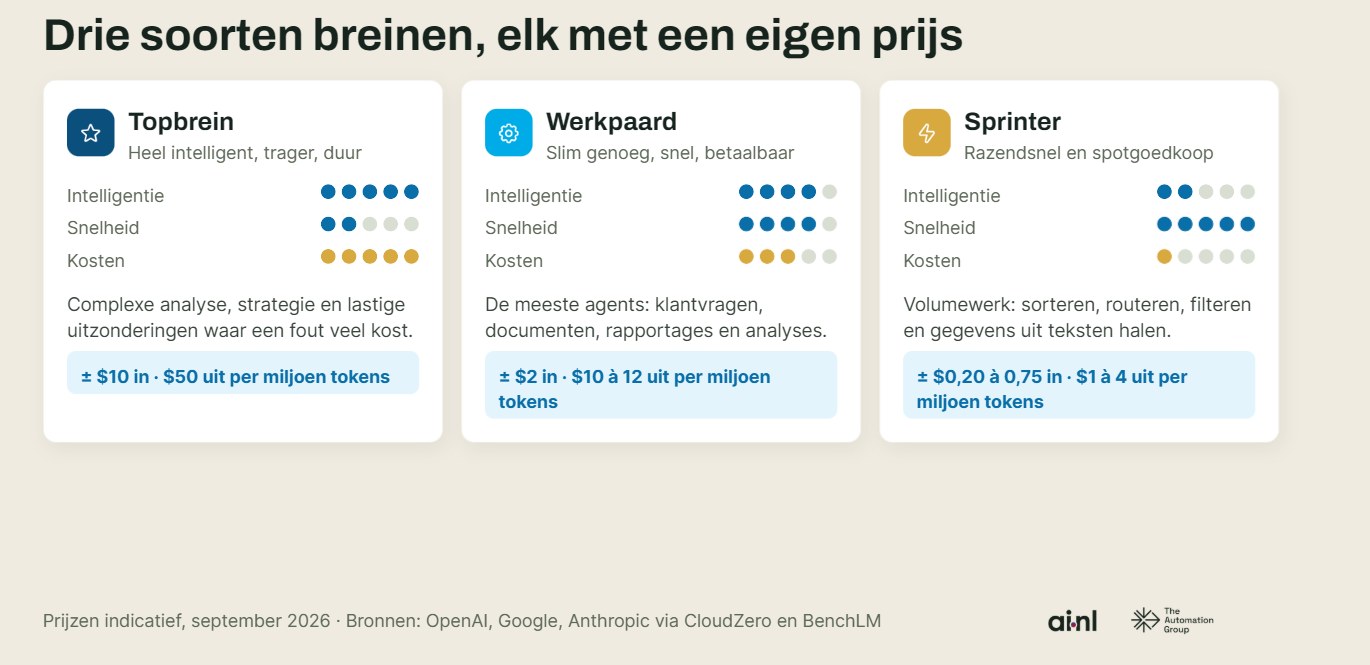
Every few months, a new flagship model appears with an impressive benchmark and an even higher price. The reflex is easy to understand: if the newest model is the smartest, let’s use it everywhere. Especially for AI agents that carry out dozens or hundreds of tasks a day, that is an expensive and unnecessary choice.
In this article, we explain why and offer a simple way to choose the right model for each task.
Why does this matter?
Suppose you want to book a flight to Barcelona this evening. You ask an AI: ‘Is there anything leaving Schiphol after 7 p.m.?’
The most advanced model first gives you a flawless explanation of airline networks, pricing dynamics, baggage rules and average delays on European flights. Then it asks for your departure date, destination, budget, hand luggage and seat preference.
A simpler, less ‘statistically smart’ model does something less impressive but more useful: it looks up current departure times and answers directly. That second model may score lower on a benchmark, but for you, at that moment, it is clearly the better model.
Exactly this happens when you use the newest, smartest AI model for every task. It costs more, it is slower and it does much more than you need. The best model is not the best model for every task, even if cost is not a concern.
The hidden costs of always using the best model
The price per token is only one side of the story. Using the heaviest model everywhere means paying in four ways.
- Money: a flagship model costs many times more per piece of text processed than a sprinter. With thousands of tasks a day, that adds up quickly.
- Speed: heavy models think for longer. For a customer waiting for a live answer, or a process with hundreds of consecutive steps, every second matters.
- Overkill: a model that explains everything in depth produces more text than you need. You have to search for the answer in a pile of explanation.
- Unnecessary complexity: the more a model ‘thinks along’, the greater the chance it interprets the assignment more broadly than intended. A clear task needs a clear executor, not a philosopher.
This is not just about saving money. A well-chosen, lighter model is simply the best solution for many tasks.
Three types of brains
You can broadly translate all the different LLM versions into three types of brains.
The top brain (think Astra, Fable or Gemini Pro). Highly intelligent, but slower and expensive. Use it for complex analysis, strategy and difficult exceptions where a mistake is costly. Only when the task is genuinely difficult.
The workhorse (think Opus, Sonnet or Gemini Flash). Smart enough, fast and affordable. This is the right model for most agents: customer questions, documents, reports and analyses. Start here.
The sprinter (for example Haiku, Grok 2-mini or Qwen Turbo). Extremely fast and very cheap. For high-volume work such as sorting, routing, filtering and extracting data from text. You do not need Einstein to categorize a thousand emails.
Top brain
- Strengths: reasoning, weighing options, exceptions and large context.
- Do not use for: high-volume routine work.
- Typical task: assessing contract risk, strategy advice or an escalation not covered by the playbook.
Workhorse
- Strengths: a good balance of quality, speed and price.
- Do not use for: very difficult or high-risk decisions.
- Typical task: answering a customer question, summarizing a report or writing an analysis.
Sprinter
- Strengths: speed, volume and fixed patterns.
- Do not use for: vague assignments where nuance matters.
- Typical task: categorizing emails, routing tickets or extracting fields from text.
The rule of thumb
Is the task clear and high-volume? Choose a lightweight model. Is the task ambiguous and a mistake costly? Choose a heavier model.
Ask yourself three questions for every task:
- Is the assignment clear and always the same shape? Then a sprinter will do.
- How many times a day does this happen? The higher the volume, the lighter the model.
- What does a mistake cost? The more expensive a mistake, the heavier the model, or the greater the need for a human reviewer.
Not sure? Start with the workhorse. If it makes too many mistakes, move up. If it is more than sufficient and the task is simple, move down. Measuring is better than guessing: test the same task with two models and compare the results.
Orchestration is the key word
That is why agents are all about orchestration. You decide which model, with how much intelligence, does the work at each moment and for each task.
A sprinter handles the incoming stream and routes it onward. The workhorse handles most of the work. The top brain only joins in when truly necessary.
This saves money, is faster and often works better, because each model does what it is good at.
Use the cheat sheet as a starting point for your next agent or use case.
Example: an agent for incoming customer emails
Take an agent that manages a webshop’s customer inbox. A smart setup uses three layers.
- The sprinter reads every incoming email, determines its type (return, delivery status, invoice question or complaint) and extracts the order number. This is high-volume work with a fixed pattern.
- The workhorse writes the reply based on the order details and the webshop’s policies. This covers most emails.
- The top brain handles only the exceptions: an angry customer threatening legal action, a claim involving contradictory policies or a case with a lot of money at stake. There are few such cases, but mistakes are costly.
The result is that most work is done with cheap, fast models, while the expensive model applies its capabilities where they make a difference.
Common mistakes
- Putting everything on the top model because it feels ‘safe’. You pay for intelligence the task does not require.
- Putting everything on the sprinter to save money. For vague or high-risk tasks, you get mistakes that cost you dearly later.
- Never testing. You only discover which model fits by comparing results on your own data.
- Locking in the model choice. Models change quickly. Build your agent so you can swap the model at each step and benefit from better or cheaper options.
- Forgetting the human. For tasks where a mistake really hurts, a review step is sometimes smarter than a heavier model.
How to get started
Take your next agent or use case and split the process into individual steps. Label each step: sprinter, workhorse or top brain. Start with the workhorse when unsure, hand routine work to the sprinter and save the top brain for moments when a mistake really costs something.
The best model is not the smartest model. It is the model that performs the task well, quickly and affordably at that moment.


Job van den Berg is an AI keynote speaker, tech entrepreneur and author of five books on AI. He ships AI agents into production every week and delivers 150+ keynotes a year on AI agents and agentic commerce.
AI can accelerate archive research, but it can also invent missing facts convincingly. How to combine the right model, strict instructions and critical verification for reliable genealogy research.
GPUs do the model math, CPUs keep the rest of the agent running. Why agentic AI shifts the view of data centers, and what that means for Intel, AMD and organizations deploying agents.
What are open weights and closed-source AI models? Discover the differences and the consequences for costs, privacy, data centers and the AI market.
On EditieNL I discussed whether AI could threaten humanity. About Anthropic researcher Evan Hubinger, agentic AI, the black box, and why we are building faster than we understand.