Why AI agents are putting Intel and AMD back in the spotlight
For years the AI chip story was about GPUs. Now that AI agents actually perform tasks, the CPU is getting attention again.
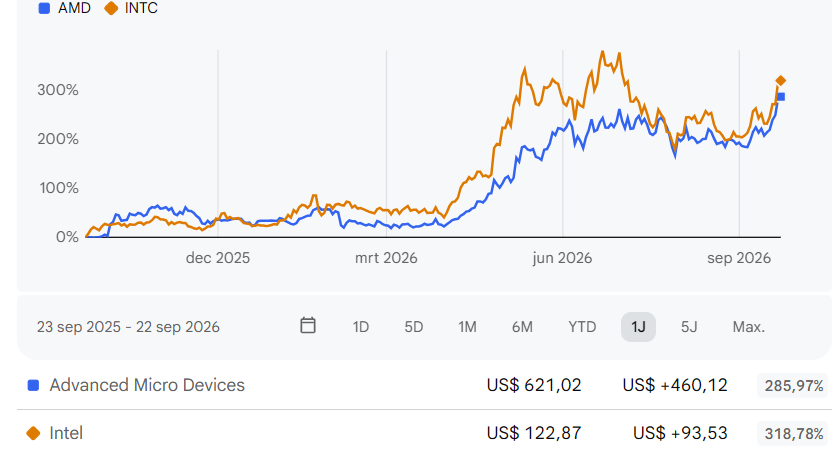
For years, the conversation about AI chips was mostly about GPUs. Nvidia became the face of the AI wave, while Intel and AMD were mainly known for the CPUs inside computers and servers. Now that AI is increasingly used to carry out tasks, those CPUs are getting attention again. That helps explain why investors are looking more positively at Intel and AMD. But what exactly changes technically?
GPU versus CPU
A GPU is a processor that can perform a huge number of calculations at once. That makes it suited to the heavy math behind AI models. When you ask a chatbot a question, the model uses that compute to produce an answer step by step. You can see the GPU as the specialist in the model's number crunching.
A CPU has a different role. It executes diverse instructions and coordinates what happens on a computer or server. It runs programs, handles requests and manages communication with other systems. The comparison is simple: the GPU does much of the heavy lifting for the AI model, while the CPU makes sure the rest of the application works. In reality they work together; an AI server needs both.
What makes an AI agent different
With a regular chatbot, the emphasis is often on generating text. An AI agent goes further. Suppose you ask it which customers have not yet received a reply and whether it can prepare a draft email. The agent may then need to fetch data from a CRM, compare customer files, check a schedule and pass the right information to the model. It can then write a draft or, if permitted, perform an action in a system.
During such a task the agent keeps switching between thinking and doing. The AI model processes information and decides the next step. The application then has to call a system, wait for data and process the result. That requires not only GPU compute, but also CPU capacity and fast connections to the systems involved. Researchers from Georgia Tech and Intel describe how CPU work can become a major bottleneck in such agent applications. That does not mean every agent is mainly slowed down by the CPU: the split depends on the task and on how the application is built.
A different view of data centers
This also changes how we look at data centers. Anyone who only looks at the speed of the AI model may miss the time lost fetching data, executing code and processing results. A more powerful GPU does not automatically make an agent faster if that agent is waiting on other parts of the system. For server CPU vendors, that creates opportunities.
Recent earnings show strong demand for data center chips. Intel reported 59% revenue growth in its Data Center and AI division for Q2 2026. AMD reported 107% growth in data center revenue in the same period, driven by demand for both CPUs and GPUs. These figures do not prove that AI agents alone are driving the growth. They do show how quickly companies are investing in the infrastructure behind AI.
The lesson for organizations
For organizations getting started with agents, the key lesson is practical. The quality of an agent depends not only on the chosen AI model. It also needs access to the right data, must communicate securely with systems and must perform its tasks fast enough. Precisely when an agent starts doing real work, it becomes clear how important the infrastructure around the model is.
For Intel and AMD this development offers an opportunity, but not a guaranteed stock market story. Both companies must be able to meet demand and compete with other chipmakers and big tech companies developing their own processors. The rise of AI agents explains why the CPU is back in the spotlight. Whether that justifies current valuations depends on what Intel and AMD ultimately deliver.


Job van den Berg is an AI keynote speaker, tech entrepreneur and author of five books on AI. He ships AI agents into production every week and delivers 150+ keynotes a year on AI agents and agentic commerce.
What are open weights and closed-source AI models? Discover the differences and the consequences for costs, privacy, data centers and the AI market.
On EditieNL I discussed whether AI could threaten humanity. About Anthropic researcher Evan Hubinger, agentic AI, the black box, and why we are building faster than we understand.
A simple AI video already costs about 4 litres of water and as much electricity as a 10-watt LED lamp burning for 42 hours. What happens with full films and commercials, and why digital is not automatically sustainable.
AI keeps getting better, yet workplace sentiment about AI is deteriorating. Research shows why adoption is as much a social challenge as a technological one: from the Matthew effect to psychological safety.