The Matthew Effect in AI: Why the Gap in the Workforce is Growing (and How Managers Can Stop It)
AI promises equal opportunities, but reality shows the Matthew Effect: the gap between frontrunners and laggards is growing. As a manager, how do you prevent a divided workforce?

The Illusion of the Great Equaliser
When generative AI like ChatGPT appeared on the scene, the promise was as utopian as it was clear: this would be the great equaliser. An intern could suddenly write like a senior copywriter. A junior programmer would produce flawless code at the speed of a veteran. The technology would give the lower end of the labour market a gigantic productivity boost, narrowing the gap between top performers and the middle tier. It sounded wonderful. But the reality in the workplace now paints a very different, much bleaker picture.
We are currently witnessing the so-called 'Matthew Effect' in AI adoption. This sociological principle, named after the parable from the biblical book of Matthew, roughly states: 'For whoever has, to him more will be given, and he will have abundance; but whoever does not have, even what he has will be taken away from him.' In other words: the rich get richer, and the poor get poorer. In the context of artificial intelligence, this means that employees who are already high-performing and digitally skilled embrace the technology and perform even better. Those who lag behind, conversely, are increasingly desperately avoiding the technology. This insight, recently sharply analysed by Job van den Berg in the science section of AI at Work Live (BusinessWise / DPG Media / New Business Radio), is now painfully and strongly substantiated by disconcerting figures from two recent, large-scale scientific publications.
The Danish Mirror: Existing Inequality on Steroids
Let's first look at the sociodemographic impact. In a broadly designed Danish study, titled 'The unequal adoption of ChatGPT exacerbates existing inequalities among workers', published by Anders Humlum and Emilie Vestergaard in the Proceedings of the National Academy of Sciences (PNAS, early 2025), it becomes painfully clear how skewed adoption really is. The researchers delved deep into the data to see who is actually using the tools, and more importantly: who is ignoring them.
The conclusions leave little to the imagination. It is primarily men, highly educated individuals, and younger employees (though for the specific group of entry-level workers, it is a bit more nuanced, as we will see) who are integrating ChatGPT and similar tools into their daily workflow. What makes this research so crucial is the finding that this unequal adoption does not level the playing field for users, but rather puts existing societal differences on steroids. An already highly educated professional with a strong network and good skills uses AI as a flywheel to double their already high output. The employee with a lower education, who has historically often been in a vulnerable position, ignores the tool due to insecurity, disinterest, or simply a lack of targeted training.
Humlum and Vestergaard show that it is not the technology itself that creates inequality, but the human reaction to it. AI is seen by frontrunners as an exoskeleton that strengthens their cognitive muscles. However, those who use the technology least often perceive it as an elusive threat. Instead of experimenting, they retreat into familiar, inefficient working methods. This is the Matthew Effect in its purest form.
The American Canary in the Coal Mine: Entry-Level Workers Are Missing Out
But it becomes even more concerning when we zoom in on the cold, hard data of the labour market itself. A paper from the prestigious Stanford Digital Economy Lab (November 2025), authored by heavyweights Erik Brynjolfsson, Bharat Chandar, and Ruyu Chen, makes quite a splash. Under the title 'Canaries in the Coal Mine? Six Facts about the Recent Employment Effects of Artificial Intelligence' they looked at wage and employment data from millions of Americans via payroll processor ADP.
Their discovery includes a statistic that should keep every HR director and CEO awake: young people aged 22-25, working in professions most exposed to AI, are currently experiencing a relative employment decline of no less than 16 per cent compared to sectors where AI has no influence. Sixteen per cent. That's not a small ripple; that's a structural shift in how companies hire new talent (or rather: no longer hire).
What do these figures explain? The researchers state that companies simply need fewer 'juniors' or entry-level positions because mid-level and senior employees, thanks to AI, can now handle the type of bulk and basic work themselves with the push of a button. Where a legion of fresh graduates was once needed to analyse data, draft texts, or write basic code, experienced employees now do this efficiently via a prompt. Young people, whom we often assume are 'digital natives' and would automatically reap the benefits of technology, turn out to be the absolute canaries in the coal mine here. They are on the sidelines because the work for which they were traditionally hired has been automated before they have a chance to prove themselves within the organisation.
The Ironic Paradox of AI Adoption
Combining the Danish PNAS study and the Stanford ADP research, we arrive at the ironic paradox of this decade, which was also aptly highlighted by Job van den Berg. It is the ultimate irony of the current AI revolution: precisely those professional groups and employees who could benefit most from artificial intelligence are the ones who embrace the technology least.
Why is this? Why does the laggard avoid their life jacket? It has everything to do with fear of failure and a lack of psychological safety in the workplace. Employees who are insecure about their position are afraid to make mistakes with technologies they don't understand. 'If it goes wrong with ChatGPT, it's my fault. If I do it the way I always did, no one can blame me,' is the unwritten, internal dialogue. The employee who already excels, on the other hand, possesses the self-confidence to play, to fail in a prompt, to shrug off the output and improve it, and then to reap the rewards in time and quality.
Practical Tools for Managers: Not a Stick, But a Carrot
Here lies a gigantic, urgent task for leadership. If you let the Matthew Effect run its course, in two years you will end up with a polarised organisation. On the one hand, a small elite of super-productive, happy 'AI centaurs' (half human, half machine), and on the other hand, a growing group of frustrated, inefficient employees who are starting to feel redundant, or in the case of the 22-25 year olds, are not even being hired anymore. That is not only bad for morale, it is disastrous for the continuity and profitability of your business.
The classic reflex in the boardroom is often to use the stick: issuing mandates. "Everyone must now achieve two AI-related targets per quarter," or, even worse: "This year we're cutting 10 per cent of the hours for project X, because AI needs to solve that." This is exactly how you push the insecure employee further into the trenches. Coercion leads to superficial adoption; people copy-paste something to keep the boss happy, but don't change their core processes.
The advice, informed by insights gained through AI at Work Live, is clear: avoid the stick, use the carrot. Shift the focus from productivity pressure to curiosity. Let people marvel. Here are four concrete, in-depth strategies to immediately reduce the gap in your workforce:
1. Cultivate Wonder Without Judgment
Organise weekly f**k-up Friday afternoons around AI. Not to show how brilliantly a prompt worked, but precisely to share how hilariously bad the bot responded and how we solved it. Make AI adoption a journey of discovery, not a KPI (Key Performance Indicator). Let employees experiment aimlessly for an hour a week during working hours. When the pressure of 'more output' disappears, there is room for genuine understanding of how a Large Language Model 'thinks'. The carrot in this case is the satisfaction of mastering something new.
2. Create Fearless 'Buddy Systems'
Don't pair the best AI whizz-kid with the biggest technophobe as a kind of tutor. That creates shame. Put equals together (for example, two employees from the HR support team or financial administration) and give them one task: "See if together you can make that one horrible chore (like formatting weekly reports) easier with Copilot or ChatGPT." Learning together greatly lowers the barrier and creates internal pillars of support for the adoption process.
3. Focus on the 'Job to be Done', Not the Technology
Stop giving training courses on "How does a Neural Network work?" or sifting through prompt-engineering theory. The average sales representative doesn't care about that. Speak the language of their pain. "Who always sighs when the monthly customer overviews need sorting? Let's see if we can do that silly job in five minutes instead of five hours." When you solve the pain points in daily routine, adoption happens naturally, and you also bring the reluctant employee on board.
4. Re-evaluate Juniors and Entry-Level Workers
Look at Brynjolfsson's alarming figure: the -16% for young workers in exposed occupations. Don't close the door on entry-level workers. If the bulk work for which they were previously hired is now done by AI, redefine the entry-level position. Teach them to start directly as AI operators and quality controllers. They don't yet have the domain knowledge of seniors, so train them alongside the technology, so they can manage the AI and senior experts can focus on strategy and human contact.
Time for Leadership with a Human Touch
Technology is an ice-cold amplifier of what already exists. If you have a company culture full of friction and inequality, the introduction of generative AI will unforgivably widen that gap. Those who flourish will soar to new heights of productivity. And the laggards will simply wither away, made redundant by their refusal to surrender to a tool they do not trust.
We must move from abstract theory to warm practice. The Matthew Effect in AI can be defeated, but only if companies realise that the introduction of this technology is the greatest change management challenge of the past fifty years. And such a challenge is not solved with cold coercion or a software licence. It is solved with empathy, the space to make mistakes, and the nurturing of genuine, human wonder about a machine that will fundamentally change us all.
"Precisely those professional groups and employees who could benefit most from artificial intelligence are the ones who embrace the technology least."
Sources
- Humlum, A., & Vestergaard, E. (2024/2025). The unequal adoption of ChatGPT exacerbates existing inequalities among workers. PNAS.
- Brynjolfsson, E., Chandar, B., & Chen, R. (Nov 2025). Canaries in the Coal Mine? Six Facts about the Recent Employment Effects of Artificial Intelligence. Stanford Digital Economy Lab.
- Discussed insights partly based on a contribution by Job van den Berg in the science section AI at Work Live (BusinessWise / DPG Media / New Business Radio).
- Best AI Tools
- GEO: discoverable in AI search engines
- Writing AI prompts

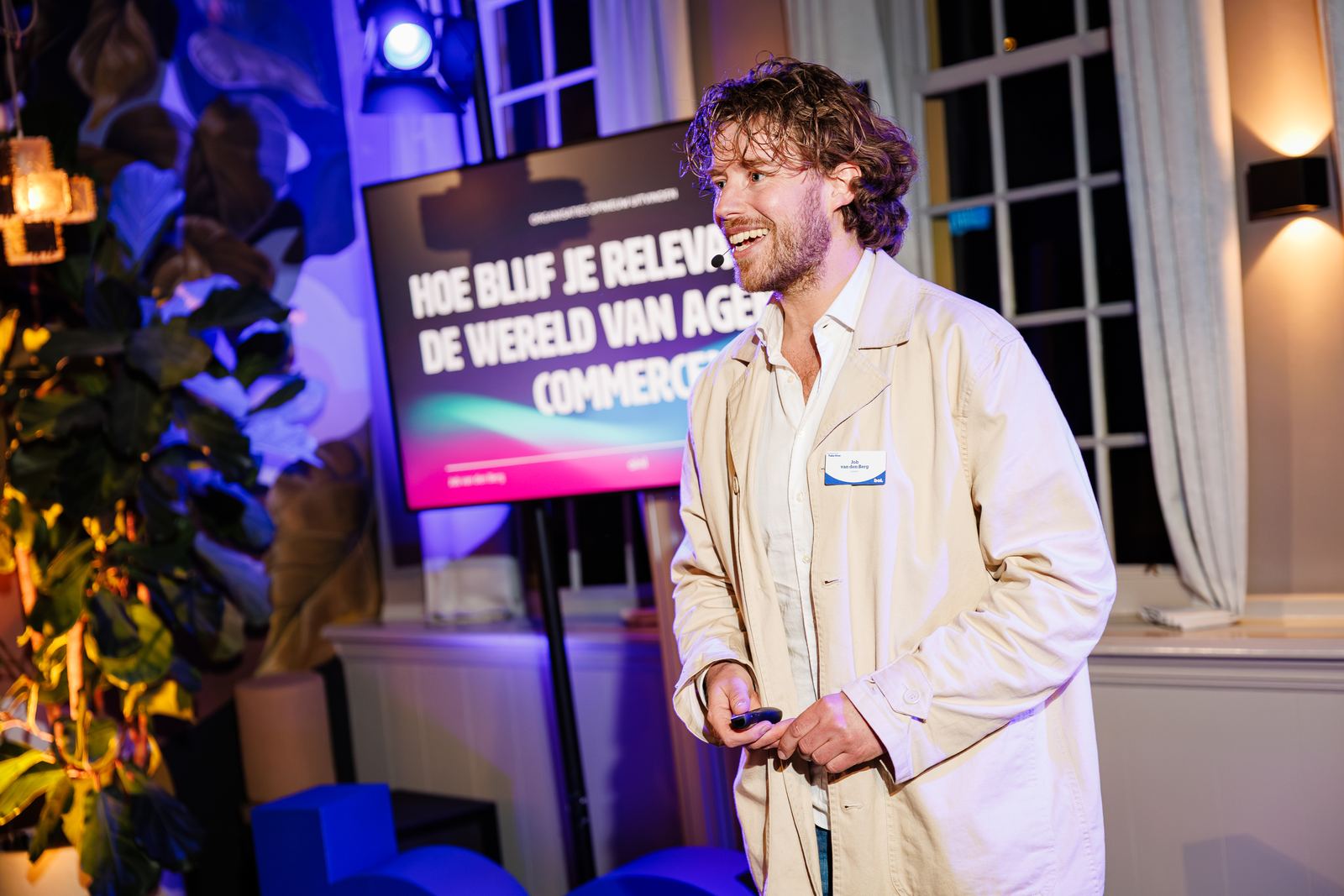
Job van den Berg is an AI keynote speaker, tech entrepreneur and author of five books on AI. He ships AI agents into production every week and delivers 150+ keynotes a year on AI agents and agentic commerce.
What are open weights and closed-source AI models? Discover the differences and the consequences for costs, privacy, data centers and the AI market.
On EditieNL I discussed whether AI could threaten humanity. About Anthropic researcher Evan Hubinger, agentic AI, the black box, and why we are building faster than we understand.
A simple AI video already costs about 4 litres of water and as much electricity as a 10-watt LED lamp burning for 42 hours. What happens with full films and commercials, and why digital is not automatically sustainable.
AI keeps getting better, yet workplace sentiment about AI is deteriorating. Research shows why adoption is as much a social challenge as a technological one: from the Matthew effect to psychological safety.