How to accelerate with AI: 4 tips for exponential thinking and innovation
At almost every company we visit, we see the same thing: organisations planning their strategy from a linear mindset. Step by step, quarter by quarter, sometimes even year by year.

And that worked. Until now.
Reality has changed. Technology no longer develops in straight lines, but in leaps. AI is the most visible example of this. Software that writes itself, code that is automatically generated, development processes that no longer take months but sometimes only days or hours.
Yet, we see that many organisations are not adapting their approach to this. They continue to think in terms of control, predictability, and small optimisations. Meanwhile, the market now demands speed, agility, and above all: the courage to think ahead.
The pitfall of linear thinking
Linear thinking is logical. It feels safe. You take one step forward, measure the effect, adjust, and repeat. But in a world where tools like Cursor, vibe coding platforms, and other AI solutions accelerate the development process by a factor of 10, that approach is simply too slow.
What is an idea today can be a working prototype tomorrow by a single developer, aided by AI.
Anyone who still works with quarterly planning and only wants to restructure next year will inherently be too late.
AI fundamentally changes the playing field
Over the past 12 months, we have experienced firsthand in our software company how fast things are moving. What used to take weeks of testing, building, and debugging, we can now accomplish in a few days. Thanks to AI tools, but especially thanks to the realisation that we must dare to think in leaps.
And we are not alone. AI makes development capacity more accessible, cheaper, and more scalable. Your competitor is also using these resources.
So the question isn't: “How can we keep up?”But: “How do we think ten steps ahead?”
Exponential thinking as a crucial skill
The most important skill right now isn't necessarily technical knowledge. It's not your tech stack, and it's not the size of your team either.
It's mindset.
The mindset to switch gears quickly.The mindset not to be afraid of fundamental course changes.The mindset to dare to think ahead in scenarios you might not be ready for today.
Exponential thinking means:
- Not “what can we optimise next month?”
- But: “what if we could make this entire model 10x faster, cheaper, or better?”
- And: “who is already doing it, while we're still planning?”
What you must do now
- Acknowledge that the rules of the game have changed.AI is no longer a hype. It is infrastructure.
- Invest in speed and resilience.Not just in tooling, but in your people's ability to work with it.
- Embrace agility in strategy.Decision-making and execution must come closer together. Don't wait for the quarterly meeting. React faster.
- Make exponential thinking part of your culture.Encourage ideas that go beyond today. Reward people who dare to look ahead.
We are at a turning point. The organisations that gain an advantage in the coming year are not necessarily the largest or the wealthiest—they are the ones who understand how fast the world is moving, and dare to think in leaps instead of steps.
Mindset is key.Not tomorrow. Now.
- Best AI tools
- GEO: discoverable in AI search engines
- Writing AI prompts

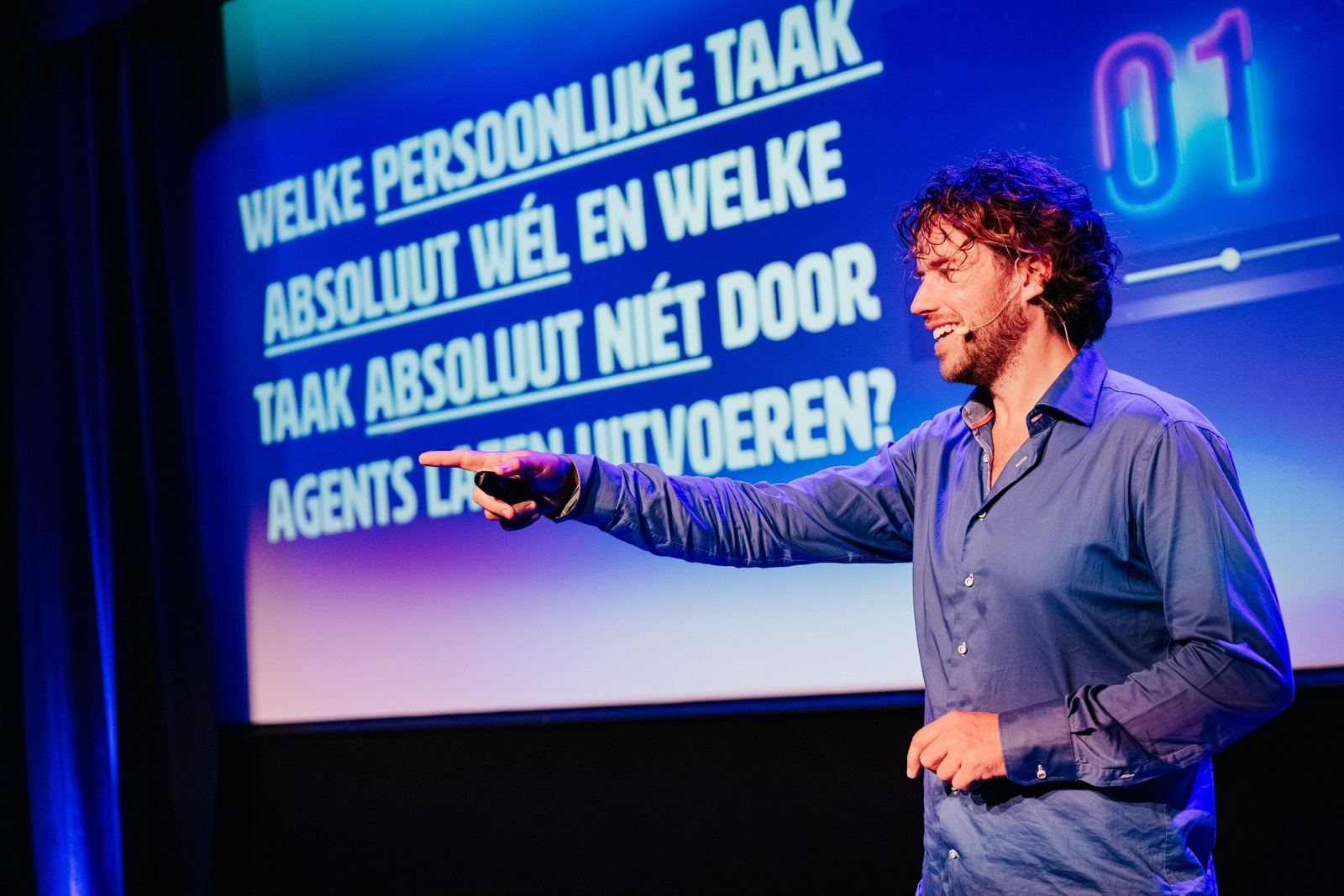
Job van den Berg is an AI keynote speaker, tech entrepreneur and author of five books on AI. He ships AI agents into production every week and delivers 150+ keynotes a year on AI agents and agentic commerce.
What are open weights and closed-source AI models? Discover the differences and the consequences for costs, privacy, data centers and the AI market.
On EditieNL I discussed whether AI could threaten humanity. About Anthropic researcher Evan Hubinger, agentic AI, the black box, and why we are building faster than we understand.
A simple AI video already costs about 4 litres of water and as much electricity as a 10-watt LED lamp burning for 42 hours. What happens with full films and commercials, and why digital is not automatically sustainable.
AI keeps getting better, yet workplace sentiment about AI is deteriorating. Research shows why adoption is as much a social challenge as a technological one: from the Matthew effect to psychological safety.