Why will Generative AI lead to such a major transformation in the workplace?
Perhaps you've wondered: what exactly is the great value of Generative AI? There's a lot of talk about its enormous potential, but what's the reason it will have such a huge impact on the workplace?

When you look at an OpenAI Sora model or one of the latest image generators that create highly realistic images, they are beautiful and interesting. But, however beautiful and interesting they may be, they will not transform your business. They deliver impressive visuals and can be useful in specific sectors, but they don't touch the core of daily business operations in the way that generative language models and AI Agents do.
So why will Generative AI lead to such a major transformation in the workplace? The answer is simple yet profound. Generative AI, particularly the language models behind ChatGPT, Copilot, Gemini and Anthropic's Claude, can understand human language and communication. This means we have technology at our disposal that can support us in all communication and decision-making processes. Human language and communication are the backbone of every organisation. It's how we convey ideas, set goals, develop strategies, and build relationships. Generative AI models that understand and can generate this language open the door to a revolution in how we work.
- Because Generative AI understands human language, it can help streamline communication within and outside the company. This leads to fewer misunderstandings, faster decision-making, and a more cohesive corporate culture.
- Gathering and analysing information is a time-consuming task. Generative AI can process and interpret vast amounts of data in a short time, making employees better informed and able to act faster.
- With deep analysis and insights that Generative AI can provide, decisions are made more quickly and based on more comprehensive information. This reduces risks and increases the likelihood of success.
The Role of AI Agents
A significant development within Generative AI is the emergence of AI Agents. These are autonomous software programmes that can independently perform tasks and make decisions based on their environment and user input. AI Agents can automate processes that previously required human intervention.
AI Agents are programmes designed to achieve specific goals through perception, decision-making, and action. They can learn from their environment and adapt to changing circumstances, which makes them particularly valuable in dynamic business environments. AI Agents can be integrated with existing software and platforms, making them fit well within current corporate infrastructure. This simplifies implementation and makes it less disruptive.
The Impact on the Workplace
- By automating routine tasks and optimising processes with the help of Generative AI and AI Agents, employees can focus on tasks that add more value to the company.
- Generative AI can act as a virtual assistant that helps with scheduling, drafting documents, and managing projects. AI Agents can proactively take actions based on pre-set goals.
- Through a better understanding of customer communication, companies can improve their service and offer more personalised experiences. AI Agents can provide real-time customer support and respond to customer questions and needs.
- The integration of Generative AI and AI Agents in the workplace means a shift in skills and roles. Employees will need to adapt and develop new competencies to collaborate effectively with these technologies.
Conclusion
Generative AI and AI Agents are the keys to a new era of efficiency and innovation in the workplace. By understanding human language and independently performing tasks, these models can transform processes that are critical to the success of any business. It's more than just a tool: it's a strategic partner contributing to the growth and progress of modern businesses.
Ignoring these technologies is not an option. Companies that embrace and integrate Generative AI and AI Agents into their daily operations will have a distinct advantage in an increasingly competitive market. It's time to recognise and harness the power of these innovations for sustainable business transformation.
- Concerns about AI
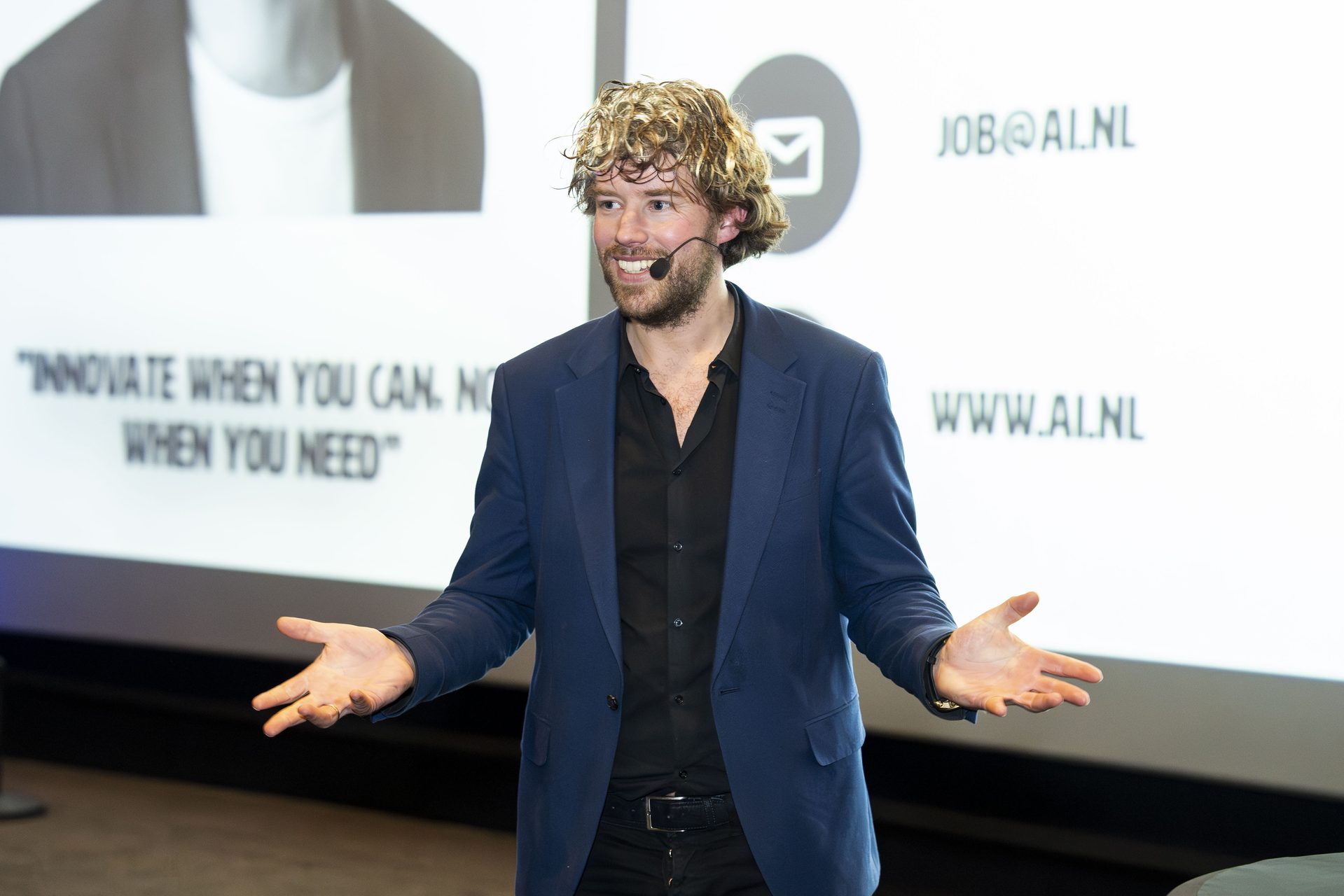

Job van den Berg is an AI keynote speaker, tech entrepreneur and author of five books on AI. He ships AI agents into production every week and delivers 150+ keynotes a year on AI agents and agentic commerce.
What are open weights and closed-source AI models? Discover the differences and the consequences for costs, privacy, data centers and the AI market.
On EditieNL I discussed whether AI could threaten humanity. About Anthropic researcher Evan Hubinger, agentic AI, the black box, and why we are building faster than we understand.
A simple AI video already costs about 4 litres of water and as much electricity as a 10-watt LED lamp burning for 42 hours. What happens with full films and commercials, and why digital is not automatically sustainable.
AI keeps getting better, yet workplace sentiment about AI is deteriorating. Research shows why adoption is as much a social challenge as a technological one: from the Matthew effect to psychological safety.