Why speaking works better than writing for AI Prompts
When working with AI, many people automatically think of typing prompts: short commands, questions, or instructions you enter to get a specific answer. But there's a method that is often much more powerful: speaking.

In this article, we explain why dictating prompts usually yields better results than writing them. Especially if you're using AI to support complex tasks like brainstorming, analysing, or advising.
1. More context, less overthinking
When you speak, you think less about the precise wording. As a result, you often automatically provide more context: what you want to achieve, what the problem is, who is involved, and why you are doing something. This extra information helps the AI to better understand your situation and, consequently, to give a better answer.
For example:
- Typed: "Write an email about the new product."
- Spoken: "I want to send an email to customers about our new product. It's an energy-saving heat pump, aimed at installers in the region. The tone should be professional, but not too technical, so that commercial people also understand it."
You can immediately see: spoken prompts are often richer and more useful.
2. You explain things more spontaneously and naturally
When speaking, you often use examples, metaphors, and everyday language. This helps the AI understand the intent behind your question. Moreover, you often explain it as you would to a colleague – precisely what you want from an AI assistant.
Spoken language is more human and less "contrived", and that makes prompts more powerful.
3. You work faster and more intuitively
A big advantage of speech is speed. You can say in 30 seconds what would otherwise take you 2 minutes to type. Especially if you're on the go, or just want to quickly try something out, speaking is the ideal form.
For example, if you use a tool like ChatGPT with voice input, you can:
- Quickly explain something and get immediate feedback.
- Organise ideas aloud.
- Brainstorm with AI in real-time almost as if you were talking to a colleague.
Practical tip: use voice when you get stuck
Are you stuck on a prompt or not getting the right answer? Speak your question aloud. Explain it as you would to a colleague or client. There's a good chance that your answer will then be much more accurate.
Conclusion
AI works better when you explain what you need more clearly. And for that, speech is a powerful tool. Not only because it's faster, but mainly because you automatically provide more context and nuance.
So the next time you use an AI: say it aloud. You'll notice that it works.
- Writing AI prompts
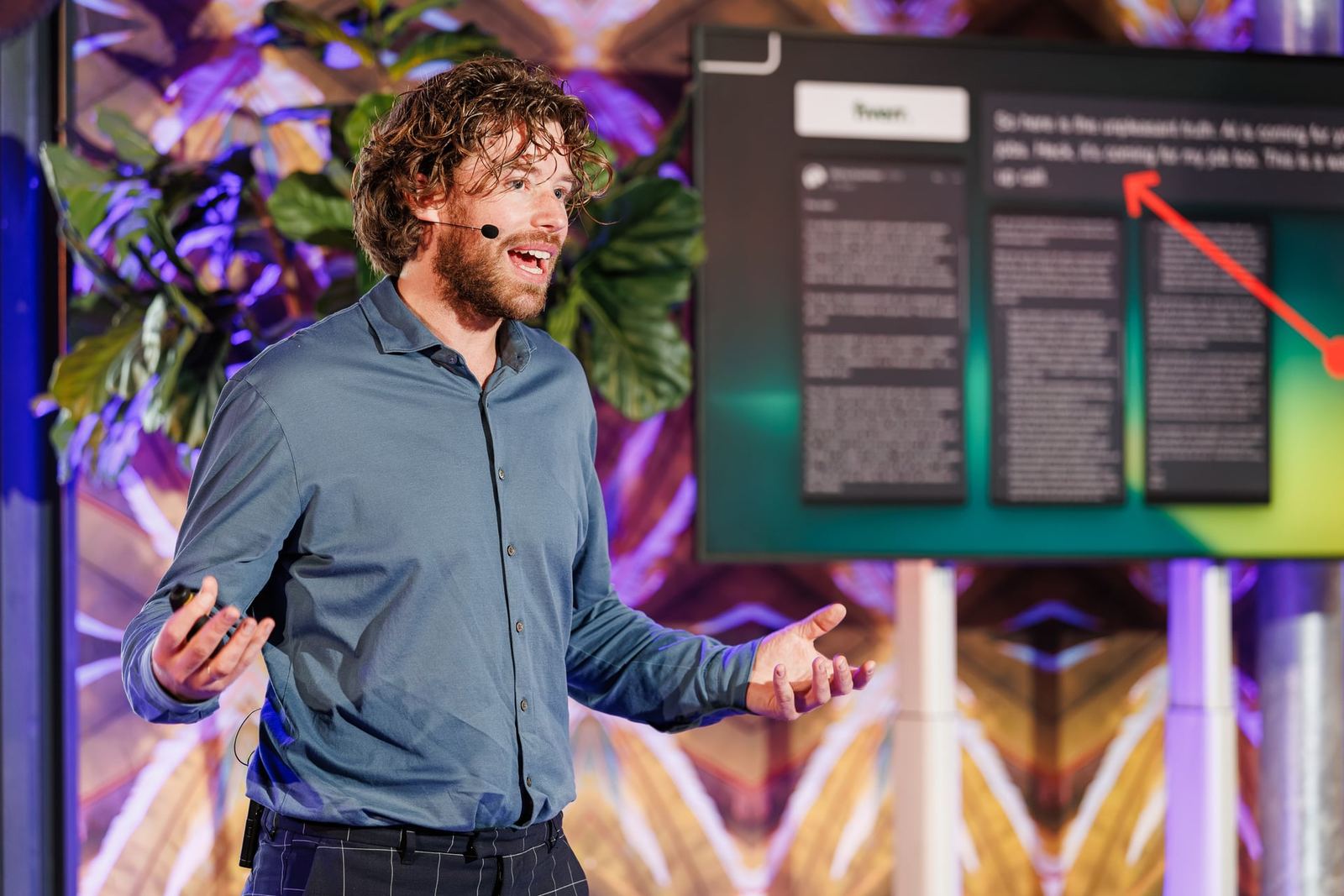

Job van den Berg is an AI keynote speaker, tech entrepreneur and author of five books on AI. He ships AI agents into production every week and delivers 150+ keynotes a year on AI agents and agentic commerce.
What are open weights and closed-source AI models? Discover the differences and the consequences for costs, privacy, data centers and the AI market.
On EditieNL I discussed whether AI could threaten humanity. About Anthropic researcher Evan Hubinger, agentic AI, the black box, and why we are building faster than we understand.
A simple AI video already costs about 4 litres of water and as much electricity as a 10-watt LED lamp burning for 42 hours. What happens with full films and commercials, and why digital is not automatically sustainable.
AI keeps getting better, yet workplace sentiment about AI is deteriorating. Research shows why adoption is as much a social challenge as a technological one: from the Matthew effect to psychological safety.