Why 'AI-washing' will soon be a thing of the past
Companies often add the term AI to everything they do to capitalise on the hype surrounding artificial intelligence. This is known as 'AI-washing'. But how long will this trend last? Our prediction is that AI-washing will drastically decline in the short term. In this article, we provide three reasons why.

We are seeing a growing trend of companies using the term 'AI' to make their products and services more attractive. This phenomenon is known as 'AI-washing'. Companies often add the term AI to everything they do to capitalise on the hype surrounding artificial intelligence. But how long will this trend last? Our prediction is that the number of companies engaging in AI-washing will drastically decline in the short term. Here are the main reasons why:
1. Investors are seeing through AI-washing
Investors are becoming increasingly critical and better informed about AI technologies. It is no longer enough to simply claim that a product or service is AI-based. Companies must be able to substantiate their AI propositions. This means they must demonstrate how AI is actually applied and what value it adds. Companies unable to prove this will quickly be penalised by the market. A concrete and proven AI application increases a company's credibility, and with it, its market value.
Why investors are becoming more critical
Investors are always looking for solid and profitable investments. The AI hype initially helped many companies attract investment, but investors have learned that not every AI claim is equally valuable. They now want to see proof of the actual application and success of AI within a company. This means companies are forced to be transparent and honest about their AI applications to convince investors of their value.
2. The impact of the EU AI Act
The EU AI Act will come into effect within two years. This legislation imposes strict requirements on companies that develop and implement AI applications, depending on the risk profile of these applications. Companies must be accountable and transparent about how they deploy AI. Non-compliance with these rules can result in hefty fines. This will lead to the opposite effect of AI-washing: companies will try to label fewer applications as AI to limit risks and regulatory burden. They will only label those applications as AI that truly deserve it and comply with legal requirements.
What the EU AI Act entails
The EU AI Act is designed to provide a framework for the use of AI within the European Union. Its aim is to promote safe and ethical AI applications by requiring companies to be transparent about their AI developments and to account for them. The law imposes different levels of oversight, depending on the risk profile of the AI application, ranging from minimal risks to high-risk applications requiring stricter controls.
3. Increased consumer awareness and trust
Consumers are becoming increasingly aware of the technologies they use and their impact on their lives. They want to know how AI uses their data and how decisions are made. Companies that are transparent and honest about their AI applications will gain consumer trust. This trust is crucial for the long-term success of any AI-driven service or product.
The importance of consumer trust
Consumer trust is a significant factor for the success of technology companies. Transparency about how AI is deployed and what data is used helps build this trust. Companies that are honest and clear about their AI use will find that consumers are more loyal and more likely to recommend their products and services to others.
Conclusion
The days of rampant AI-washing are numbered. Investors are becoming sharper in their evaluation of AI claims, and upcoming EU legislation is forcing companies towards greater transparency and accountability. Companies unable to prove that their AI applications are genuine will lose market share and credibility. This will create a cleaner, fairer market where genuine AI innovations are recognised and valued.
Due to the factors mentioned above, the number of companies engaging in AI-washing will drastically decrease, ultimately benefiting both the industry and consumers. By being transparent and honest about AI applications, companies satisfy investors and regulators, and moreover, they win the trust and loyalty of consumers.
- Best AI tools
- GEO: discoverable in AI search engines
- Writing AI prompts

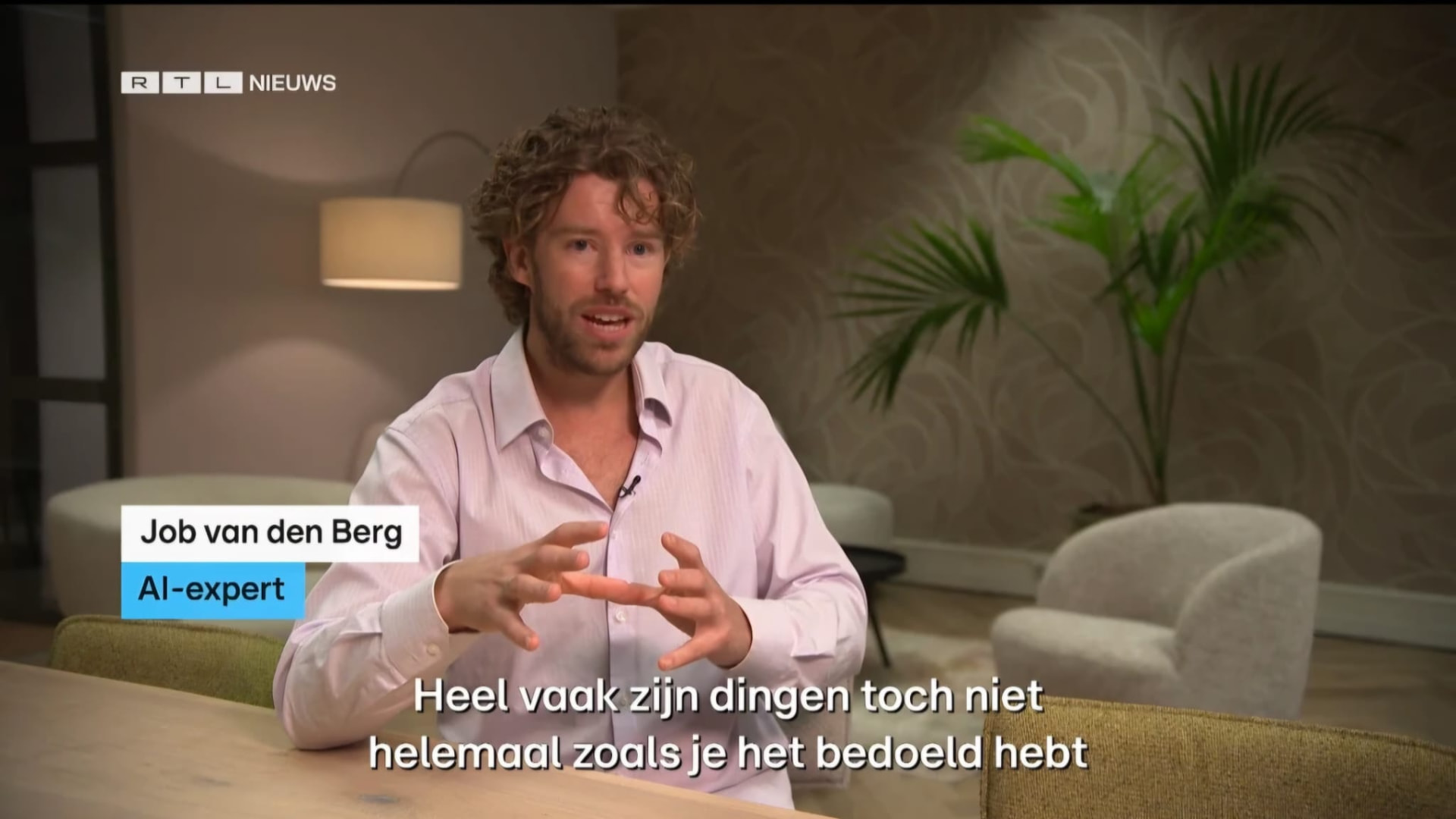
Job van den Berg is an AI keynote speaker, tech entrepreneur and author of five books on AI. He ships AI agents into production every week and delivers 150+ keynotes a year on AI agents and agentic commerce.
What are open weights and closed-source AI models? Discover the differences and the consequences for costs, privacy, data centers and the AI market.
On EditieNL I discussed whether AI could threaten humanity. About Anthropic researcher Evan Hubinger, agentic AI, the black box, and why we are building faster than we understand.
A simple AI video already costs about 4 litres of water and as much electricity as a 10-watt LED lamp burning for 42 hours. What happens with full films and commercials, and why digital is not automatically sustainable.
AI keeps getting better, yet workplace sentiment about AI is deteriorating. Research shows why adoption is as much a social challenge as a technological one: from the Matthew effect to psychological safety.