Why agentic AI is not inherently cheaper or more efficient than human labour
Agentic AI is not always inherently more efficient than human labour. Sometimes AI can even turn out to be more expensive, especially when organisations deploy heavy models for simple tasks without clear choices. And precisely now that AI is being integrated into more and more business processes, this is becoming a fundamental question.

Artificial intelligence is often presented as the logical route to greater efficiency. Companies hear daily that AI makes processes faster, performs work more cheaply, and makes organisations more productive. This quickly leads to the idea that if an AI can perform a task, that task is automatically done better, faster, and more affordably than by a human. But that's precisely where a major fallacy lies.
AI is not inherently more efficient than human labour. In many cases, AI can even turn out to be more expensive, especially when organisations deploy heavy models for simple tasks without clear choices. And precisely now that AI is being integrated into more and more business processes, this is becoming a fundamental question. Because as soon as you start using AI on a large scale, model choice, cost per task, and the design of the human-machine collaboration become much more important than many companies realise today.
What we've learned from the latest generation of AI models is that it's tempting to use the heaviest and smartest model for everything. That feels safe: you're opting for maximum intelligence, so the quality will surely be the best. However, from a business economic perspective, this is not always wise. If you use the most advanced model for simple emails, standard summaries, meeting minutes, or other routine tasks, costs can quickly escalate. Especially when such a model runs in dozens or hundreds of daily workflows, you're no longer talking about a handy innovation, but a structural cost item that in some cases becomes more expensive than human effort.
And that's an important insight: the question isn't just whether AI can perform a task. The real question is whether AI performs that task at the right price, with the right quality level, and within the right process design.
A good way to understand this is by looking at people. In no healthy company do you automatically assign your smartest and most expensive specialist to every task. You don't ask a scientist to answer emails all day. And you probably don't have the organisation's greatest strategic genius writing all the meeting minutes. Not because those people couldn't do it, but because their capacity is simply too valuable to be used in that way. It's inefficient, expensive, and organisationally illogical.
It works exactly the same with AI. The most powerful model can often handle most tasks, but that doesn't mean it's the right choice for all of them. Deploying a heavy model for simple, repetitive actions is essentially like using top-tier expertise for work that doesn't require it. You're paying for a level of intelligence you don't practically need.
That's precisely why model choice becomes so important. Not every task requires deep reasoning, advanced analysis, or maximum context processing. Many business activities are relatively predictable: standard emails, first drafts of texts, simple customer queries, summaries, classifications, internal searches, or basic reports. For such work, a lighter, faster, and cheaper model is often more than sufficient. Sometimes a human is even still faster, more reliable, or cheaper, especially when a task has little economies of scale or requires strong context, nuance, or responsibility.
As long as AI is tested on a small scale, this problem often remains invisible. In pilots, almost everything seems valuable because the focus is mainly on what is technically possible. But as soon as AI is rolled out widely across the organisation, reality changes. You then deal with enormous volumes of prompts, documents, analyses, emails, and interactions. At that point, tokenization, computational capacity, and cost per model suddenly become hard business-economic factors. What seemed clever in a demo can turn out to be financially unsustainable at scale.
Therefore, the real management question shifts. The question of the future is not: how can we use AI? The much more important question is: which model do you use for which task, and when is human input still the better choice?
This is not purely a technical issue. It simultaneously concerns strategy, cost control, process design, and quality. Organisations will need to learn to look much more sharply at the nature of the work. How complex is a task really? How significant is the impact of errors? How much quality is actually needed? What does the model cost per task, per workflow, and at scale? And where does human involvement still undeniably add value?
Because that's where the next misconception lies: that AI is primarily about replacement. As if the choice is always between human or machine. In reality, the greatest gains are usually found in the combination. Not everything needs to be done by humans, but certainly not everything needs to be fully automated. The art is to design processes so that AI does what AI is strong at, and people do what people add value to.
AI is strong in speed, scale, pattern recognition, creating first drafts, and processing large amounts of information. Humans are strong in context, empathy, judgment, creativity, relational alignment, and responsibility. Companies that cleverly combine these two build processes that look more modern and actually work better.
And precisely there, a new core skill for organisations emerges: AI orchestration. The real winners of the coming years are probably not the companies that simply apply AI everywhere, but the companies that understand how to cleverly deploy different models, how to control costs, and how to effectively organise the collaboration between humans and machines.
This skill is about much more than just prompting or knowing tools. It's about understanding which model suits which task. When a light model is sufficient. When a heavier model truly adds value. When human control remains necessary. And when a task is simply better left to an employee, because automation in that case is more expensive or less effective.
That makes model choice one of the most important skills of the future. Not because technology is becoming less important, but precisely because AI is becoming universally available. The wider its deployment, the more important it becomes to choose wisely. The organisations that excel at this will manage AI more smartly, and thus also better manage their people, processes, and margins.
The future is therefore not for companies that blindly automate everything. The future is for companies that understand that efficiency does not arise from deploying maximum intelligence everywhere, but by choosing the right combination of model, human, and process for each task.
AI can do an incredible amount, but that doesn't mean AI is always the cheapest or most efficient worker. Sometimes it is. Sometimes it isn't. And precisely the ability to make that distinction well will become one of the most valuable competencies of our time.
Want to get started with AI yourself? Check out our AI Agents e-learning or AI workshops for teams.
- Best AI Tools
- GEO: discoverable in AI search engines
- Writing AI prompts

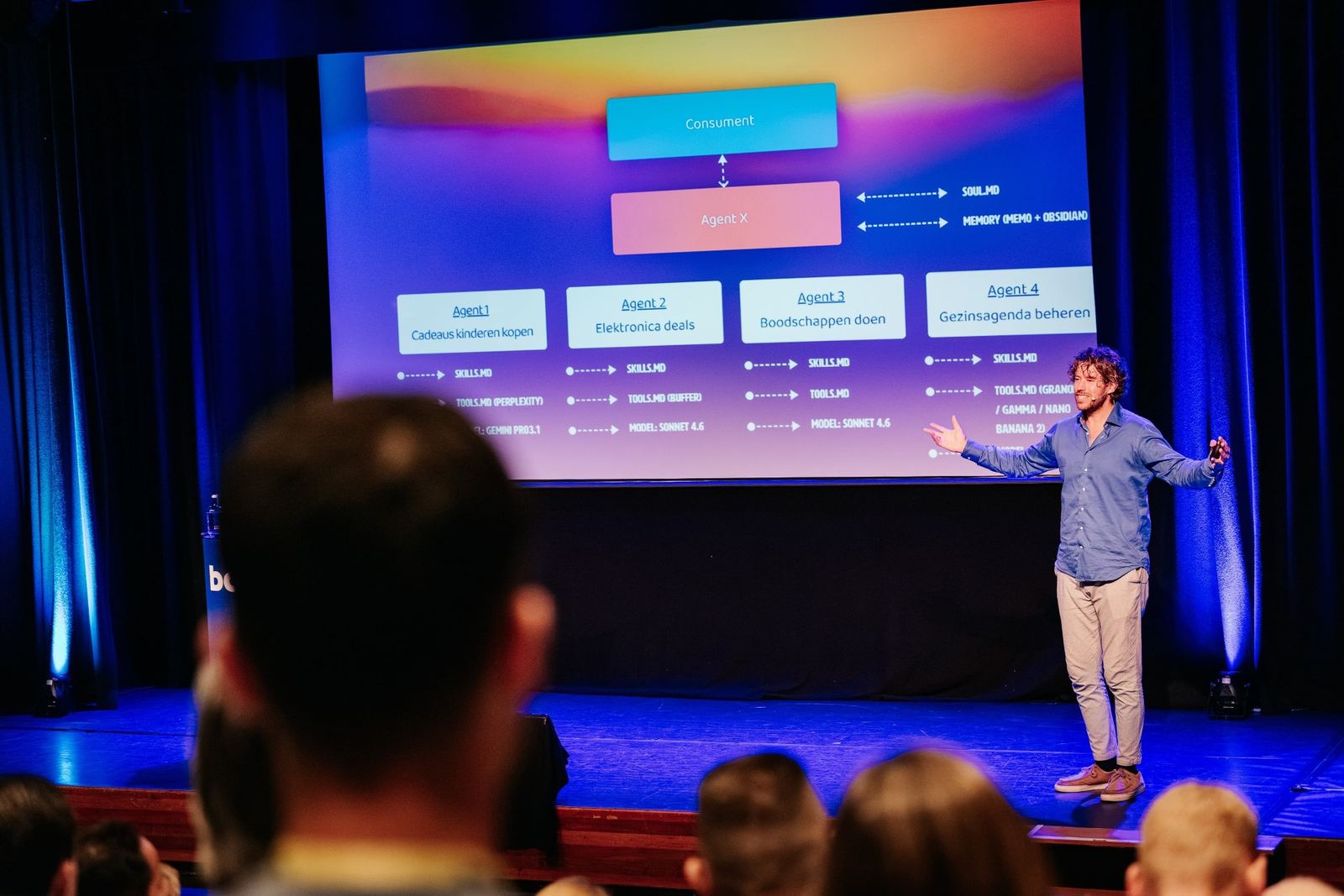
Job van den Berg is an AI keynote speaker, tech entrepreneur and author of five books on AI. He ships AI agents into production every week and delivers 150+ keynotes a year on AI agents and agentic commerce.
What are open weights and closed-source AI models? Discover the differences and the consequences for costs, privacy, data centers and the AI market.
On EditieNL I discussed whether AI could threaten humanity. About Anthropic researcher Evan Hubinger, agentic AI, the black box, and why we are building faster than we understand.
A simple AI video already costs about 4 litres of water and as much electricity as a 10-watt LED lamp burning for 42 hours. What happens with full films and commercials, and why digital is not automatically sustainable.
AI keeps getting better, yet workplace sentiment about AI is deteriorating. Research shows why adoption is as much a social challenge as a technological one: from the Matthew effect to psychological safety.