Soon, consumers won't buy from you; their agents will. And they forget nothing.
Why the biggest blind spot in Agentic Commerce isn't your discoverability, but your customer service.

Why the biggest blind spot in Agentic Commerce isn't your discoverability, but your customer service.
Everyone is talking about Agentic Commerce. The term pops up at every conference, in every strategy session, and in every trend report. Companies are investing heavily in AI discoverability, product feeds, and content that is picked up by language models. And rightly so, because that is the new shop window.
But almost no one realises what consumers will actually be doing soon. And it is precisely there that the shift lies which will determine which companies will still be in business in a few years.
Still for nerds today
Let's be honest: right now, you still need to be a bit of a nerd to build your own AI agents. Tools like Claude Code, OpenClaw or Hermes already make it possible. Today, you can set up an agent to monitor your inbox, compare prices or manage your calendar. But it requires technical knowledge, patience, and a willingness to tinker. It is still the domain of early adopters, the people who already had a modem in 1995.
And that's how almost every technological revolution begins. Small, awkward, and for insiders.
Give it a year
Then it will be as simple as sending an email. No code, no settings, no technical knowledge. You just say: sort out my groceries, this is my budget, and this is what we like to eat.
And just like with the advent of the internet, it suddenly becomes a no-brainer. Not because everyone understands AI, because no one in 1998 had to understand how the internet technically worked to book a holiday online. People switch because they experience the benefits: time, convenience, and money. Adoption never comes from understanding; adoption comes from benefit.
And then every consumer will have their own team of AI agents.
Every household its own team of agents
This is what it will look like.
Grocery Agent
Knows what's in the fridge, what the weekly menu is, and where the special offers are.
Travel Agent
Monitors prices, rebooks in case of delays, and knows you never want to sit in a middle seat.
Gift Agent
Remembers all birthdays and arranges something suitable on time.
Finance Agent
Cancels subscriptions, compares energy contracts, and switches as soon as it pays off.
Customer Service Agent (the forgotten agent)
Handles returns, complaints, and invoices. Doesn't wait, doesn't give up, and records every experience as data.
Every household will get an agent for groceries, who knows what's in the fridge, what the weekly menu is, and where the special offers are. There will be an agent for travel, who monitors prices, rebooks in case of delays, and knows you never want to sit in a middle seat. A gift agent remembers all birthdays and arranges something suitable on time. And a finance agent cancels subscriptions, compares energy contracts, and switches as soon as it pays off.
These agents do the work for the consumer and increasingly make decisions themselves. The consumer sets the parameters, and the agent handles it. Which supermarket the groceries come from will interest the consumer just as little as the route by which their email is delivered.
But there is one agent that appears in almost no future scenario. And that might be the most important one of all.
The forgotten agent: customer service
What almost no one includes in the story is the agent who, on behalf of the consumer, interacts with customer services.
Think along with me. A package doesn't arrive, a return isn't processed, or an invoice is incorrect. Today, that means hold music, a chatbot that doesn't understand you, and having to repeat your story three times. The consumer gives up, swallows the loss, or leaves an angry review.
Soon, their agent will do that work. And that agent won't call in frustration, won't wait in a queue, and won't give up. They will handle it and record everything. How quickly was the problem resolved? Was the promise kept? How many contact moments were needed? Everything will be recorded and remembered. Not as a vague memory, but as data.
From website visitors to negotiating agents
The consequence is easy to guess. Soon, it won't be millions of people visiting websites and viewing advertisements, but millions of personal AI agents communicating with each other and with companies on behalf of consumers and making decisions based on data.
Consider what that means for everything marketing currently relies on. There will be no more impulse purchases due to a clever banner, because agents don't click on ads. There will be no brand preference out of habit, because agents have no habits, only criteria. The excuse of one bad experience that everyone eventually forgets will no longer exist, because agents weigh every experience. And grand promises on the homepage won't impress, because agents look at what has actually been delivered.
The entire funnel as we know it, from attracting attention to enticing and converting, is built on human psychology. Agents have no psychology. They have a task and a dataset.
And that is precisely what is missing from almost every discussion about Agentic Commerce.
Reputation becomes machine-readable. And a reputation that machines can read is mercilessly consistent.
Your service becomes your dossier
Companies are now fully focused on the front end: being found by AI, the right product feeds, and optimised content. All necessary and all sensible. But it's only half the story.
Because if your service is not in order, every customer service agent will build a dossier. About you. About your response time, about how often you keep your promises, about how smoothly your return process runs, and about the difference between what you promise and what you deliver.
And that dossier will soon determine whether you are even considered in the next purchasing decision. Not by a consumer who has long forgotten the incident, but by an agent who forgets nothing.
What's more, those dossiers will probably not remain private. Just as reviews are shared now, agents will start sharing and consolidating their experiences. One structurally bad return process will then not be one lost customer, but a signal that thousands of agents weigh in. Reputation becomes machine-readable. And a reputation that machines can read is mercilessly consistent.
What does this mean already?
Anyone who wants to get ahead here doesn't have to wait for the breakthrough. The direction is clear.
It starts with the recognition that your customer service is not a cost centre, but will soon literally be your admission ticket to the next transaction. Every resolved complaint is a data point in your favour, and every broken promise a data point against you.
Furthermore, critically examine the difference between what you communicate and what you deliver. A promise of a response within 24 hours that actually takes 72 hours can still be smoothed over with people. With an agent, it is simply a promise that was not kept.
And prepare for your customer service to soon be talking to agents instead of people. This requires processes that are consistent, verifiable, and machine-readable. Not scripts written to placate people.
The conclusion
Agentic Commerce is not just about being discoverable to AI. It's about being reliable for AI. Companies that currently only invest in the shop window forget that the agent of tomorrow will primarily look at what happened after the purchase.
So the question isn't whether your company is ready for AI agents as customers. The question is: what will be in your dossier soon?
Job van den Berg is an AI keynote speaker, tech entrepreneur and author of five books on AI. He puts agents into production himself weekly and gives 150+ keynotes per year on AI agents and agentic commerce.
Counting Cybertrucks in the back seat is not representative research. But it is a perfect example of how statistics, logical thinking and AI come together: observe, formulate hypotheses and, above all, try to disprove them.
After half a year back in Silicon Valley, one thing stands out: the conversation is shifting from 'what can AI do?' to 'how do we really build on it?'. Billboards about safe AI, control and infrastructure show a new theme.
Hallucinations can be controlled. Much more difficult is reasoning that sounds logical, is partly supported by research, yet goes further than the evidence allows. About generational differences, statistics and methodological caution as an AI skill.
The promise of AI agents is zero friction, convenience first. But precisely in that friction, the contact that forges our social capital always arose. An essay on connection, technology and the default setting.

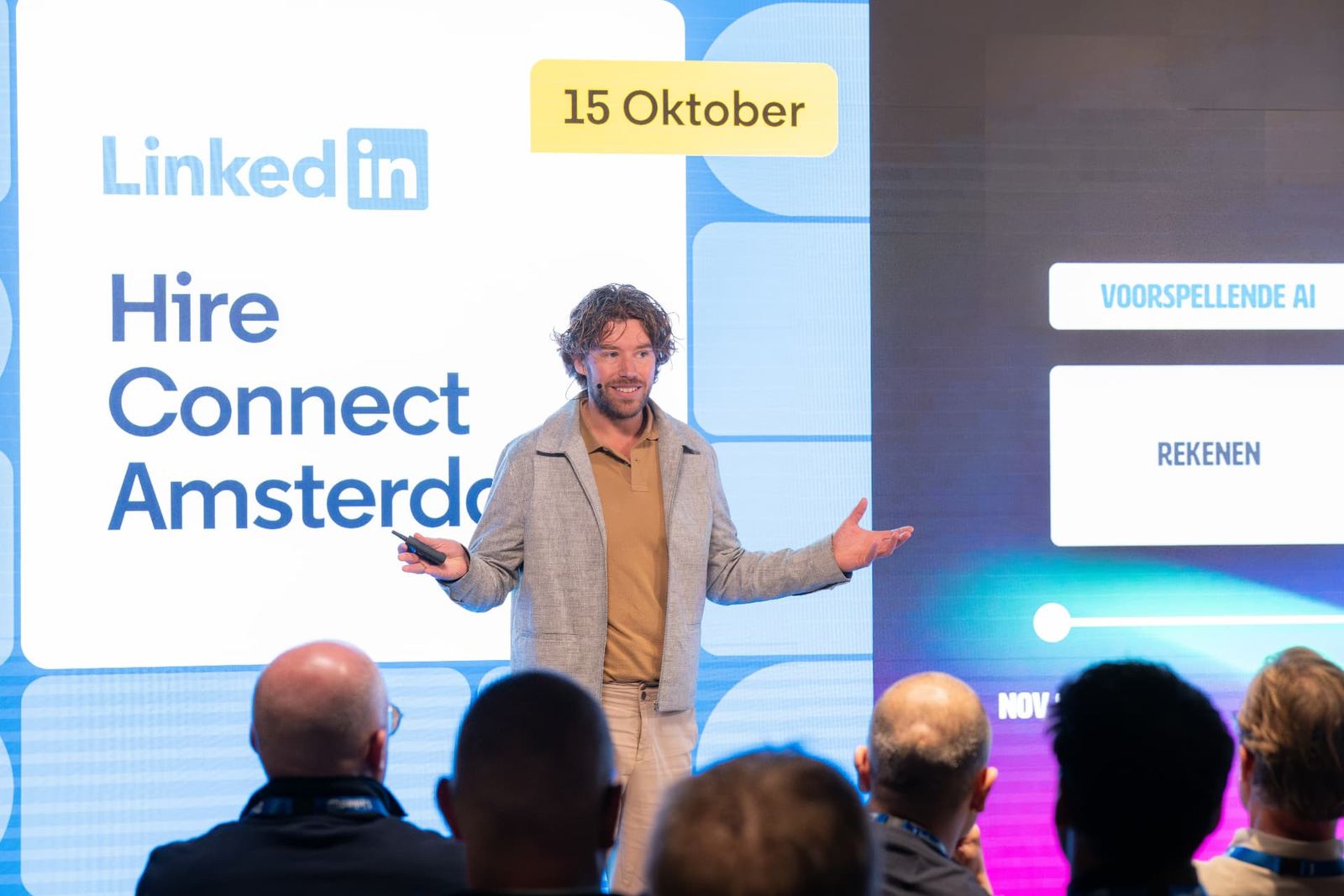
Job van den Berg is an AI keynote speaker, tech entrepreneur and author of five books on AI. He ships AI agents into production every week and delivers 150+ keynotes a year on AI agents and agentic commerce.
The short answer: by being able to say, at any moment, what each agent does, which model it runs on, which data it works with and since when. If you don't know that, you can't call an agent safe, however good the technology around it is. You capture that overview in a passport per agent, which you update with every change and review every quarter. Below is how that works and why it is more than paperwork.
Intelligent AI agents need a reliable data foundation. Identity resolution, Customer 360, data orchestration and governance: from a single source of truth to a system of context.
Top brain, workhorse or sprinter? Choose the right AI model for each task and balance quality, speed and cost with smart AI-agent orchestration.
AI can accelerate archive research, but it can also invent missing facts convincingly. How to combine the right model, strict instructions and critical verification for reliable genealogy research.