The silent divide: how AI widens inequality in the workplace
In recent months, we've noticed a shift at keynotes and sessions. Where, until recently, the audience was largely in the same phase of wonder, initial experiments, and questions about what's possible, the room is now visibly splitting.
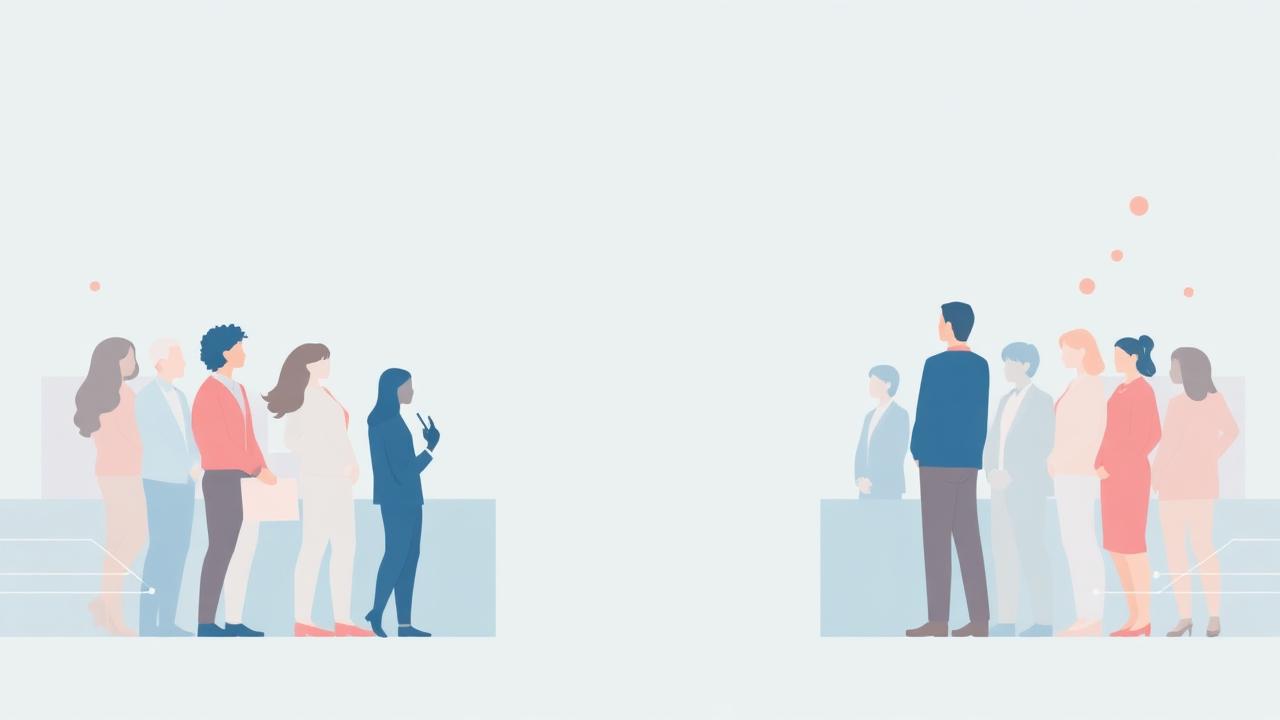
On one side, colleagues who still need to discover what AI actually is. For them, uncertainty predominates: what will change for my profession, for my workday, for my role in two years?
On the other side, people who have been working daily with tools like ChatGPT and Claude Cowork for months. They no longer talk about whether AI adds something – they've answered that question – but about how they have re-engineered their workflows, which models they use for what, and how they bring their teams along.
The gap between these two groups grows larger every month. And that's not just anecdotal. Research now shows it very concretely.
The promise versus the reality
In the first months after ChatGPT's launch, a popular thesis was that AI would level the playing field. Less experienced colleagues would receive extra support from the tool, backlogs would diminish, and overall productivity would increase.
For specific, defined tasks, there is indeed evidence for this in research – consider the work of Brynjolfsson, Li, and Raymond in call centres, or Noy and Zhang with writing tasks. There, AI compressed productivity differences within a defined task.
However, those who follow the broader literature observe a different pattern emerging in the workplace: AI actually reinforces existing differences between colleagues, rather than mitigating them.
What the research shows
Sixfold difference within the same company
In December 2025, OpenAI published data on its more than one million business customers. The finding: within one and the same company, the top 5% of AI users send six times as many messages to ChatGPT as the median colleague. For coding tasks, this rises to seventeen times.
This is not about differences between companies, or between industries. This is about differences between colleagues with the same access, in the same team. The infrastructure is available to everyone; usage differs fundamentally.
Those who use ChatGPT already earned more
A large-scale study in PNAS from 2024 surveyed 18,000 Danish employees in eleven professions where AI is relevant. The uncomfortable conclusion: people who use ChatGPT at work already earned more before ChatGPT existed.
AI adoption is therefore not among the group that could statistically benefit the most from it. It is precisely those people who are already ahead who also adopt this new layer of productivity. The paper bears a title that leaves no room for doubt: "The unequal adoption of ChatGPT exacerbates existing inequalities among workers."
Within this, another divide stands out: women are sixteen percentage points less inclined to use ChatGPT for work, even within the same role and with the same employer.
The divide widens, not narrows
Research from USC Marshall from 2025 confirms the picture at a macro level. The so-called "GenAI digital divide" between early and late adopters is not shrinking but being further magnified. Younger and more highly educated employees are already deep into the learning curve. Others are still at the start. And the pace at which this difference is increasing is higher than with previous technological transitions.
The belief trap
An arXiv paper from 2024 (Learning to Adopt Generative AI) describes a self-reinforcing mechanism that researchers call the "belief trap." Those who underestimate the utility of AI do not use it. Those who do not use it do not gain experience that can adjust that judgment. And so, the underestimation and thus the отсталость (lag) persist.
This is what many leaders are now seeing happen in their own organisations: a group of employees who simply don't get around to experimenting, not because the tools are lacking, but because the first introduction was disappointing, or because there seems to be no immediate reason.
Why this works exponentially
What makes this gap so special and grow so much faster than in previous waves is the exponential nature of AI fluency.
Those who work with new models weekly build an intuition that cannot be learned from a manual. Which prompts work in which context. Which model to use for what. When to do something manually and when to delegate it. This intuition compounds: each experience makes the next experience more valuable.
Erik Brynjolfsson (Stanford) described it in early 2026: a small group of power users automate entire work processes end-to-end and accomplish in hours what takes others weeks.
The laggard not only has less fluency today. They also have less experience on which tomorrow's fluency can be built. The difference slowly shifts from a learning deficit to a fundamental difference in value for the organisation.
What this means for leaders
The phase where we have to tell people what AI is, is over for more and more organisations. The question now is a different one: how do you keep everyone in your organisation moving at the same pace?
A few considerations that deserve more attention in this light.
Access is not the same as adoption. The OpenAI report clearly shows that distributing licenses is not a solution. In the same companies with the same tools, factor-6 to factor-17 differences arise. What is usually missing is not the tool, but the structure around its use: peer learning, concrete examples, regular rhythms for teams to experiment together.
It's not the technology, but the habit that makes the difference. People who become productive with AI usually haven't learned harder than others; they've tried more often. The threshold for picking it up daily is low, and that alone kicks off the learning curve. Organisations that consciously facilitate that rhythm – for example, with weekly "AI hours" or explicit time to redesign workflows – demonstrably reduce the adoption gap.
Insight into who is falling behind. The PNAS data shows that those falling behind often have an identifiable profile. Older employees, women, people who were already less visible in the organisation before the advent of AI. Those who do not actively pay attention to who is not participating unintentionally create a divide that also reinforces other existing inequalities.
Time to catch up evaporates faster than we think. Due to the exponential nature of the learning curve: the later you start, the more there is to catch up on. A training day in a year is no longer a solution for those not yet participating now. The difference is not in knowledge that can be transferred in a day, but in hundreds of small experiences that colleagues have already accumulated.
Finally
We are beyond the phase of enthusiastically explaining all that AI can do. What is now unfolding in organisations is a silent divide: between colleagues who no longer speak the same language, between teams that no longer work at the same pace, between people who will soon not be able to be judged by the same standards.
The same organisation. The same job title. Two different worlds.
The question is no longer whether that difference arises – it's already happening. The question is who within organisations takes responsibility for ensuring that the gap does not become irreversible.
Sources
- OpenAI (December 2025). ChatGPT usage and adoption patterns at work. Analysis of usage patterns among over one million business customers.
- Humlum, A. & Vestergaard, E. (2024). The unequal adoption of ChatGPT exacerbates existing inequalities among workers. Proceedings of the National Academy of Sciences (PNAS).
- USC Marshall School of Business (2025). Research on the GenAI digital divide and household adoption.
- Liu, Y., Sun, T., & Wu, X. (2024). Learning to Adopt Generative AI. arXiv preprint 2410.19806.
- Brynjolfsson, E. (February 2026). The AI productivity take-off is finally visible. Financial Times / Fortune.
- Brynjolfsson, E., Li, D., & Raymond, L. R. (2023/2025). Generative AI at Work. NBER Working Paper 31161 / Quarterly Journal of Economics.
- Noy, S. & Zhang, W. (2023). Experimental evidence on the productivity effects of generative artificial intelligence. Science.
Prevent an AI divide in your organisation
The best way to close the gap is to bring everyone along. We help with AI training for teams, a tailored AI Workshop, or an AI keynote that mobilises the entire company.
- Best AI tools
- GEO: findable in AI search engines
- Writing AI prompts

Job van den Berg is an AI keynote speaker, tech entrepreneur and author of five books on AI. He ships AI agents into production every week and delivers 150+ keynotes a year on AI agents and agentic commerce.
What are open weights and closed-source AI models? Discover the differences and the consequences for costs, privacy, data centers and the AI market.
On EditieNL I discussed whether AI could threaten humanity. About Anthropic researcher Evan Hubinger, agentic AI, the black box, and why we are building faster than we understand.
A simple AI video already costs about 4 litres of water and as much electricity as a 10-watt LED lamp burning for 42 hours. What happens with full films and commercials, and why digital is not automatically sustainable.
AI keeps getting better, yet workplace sentiment about AI is deteriorating. Research shows why adoption is as much a social challenge as a technological one: from the Matthew effect to psychological safety.