The shirt that confuses AI facial recognition
Why a rainbow camouflage shirt outsmarts a surveillance system, and why that only works temporarily.
Why a rainbow camouflage shirt outsmarts a surveillance system, and why that only works temporarily.
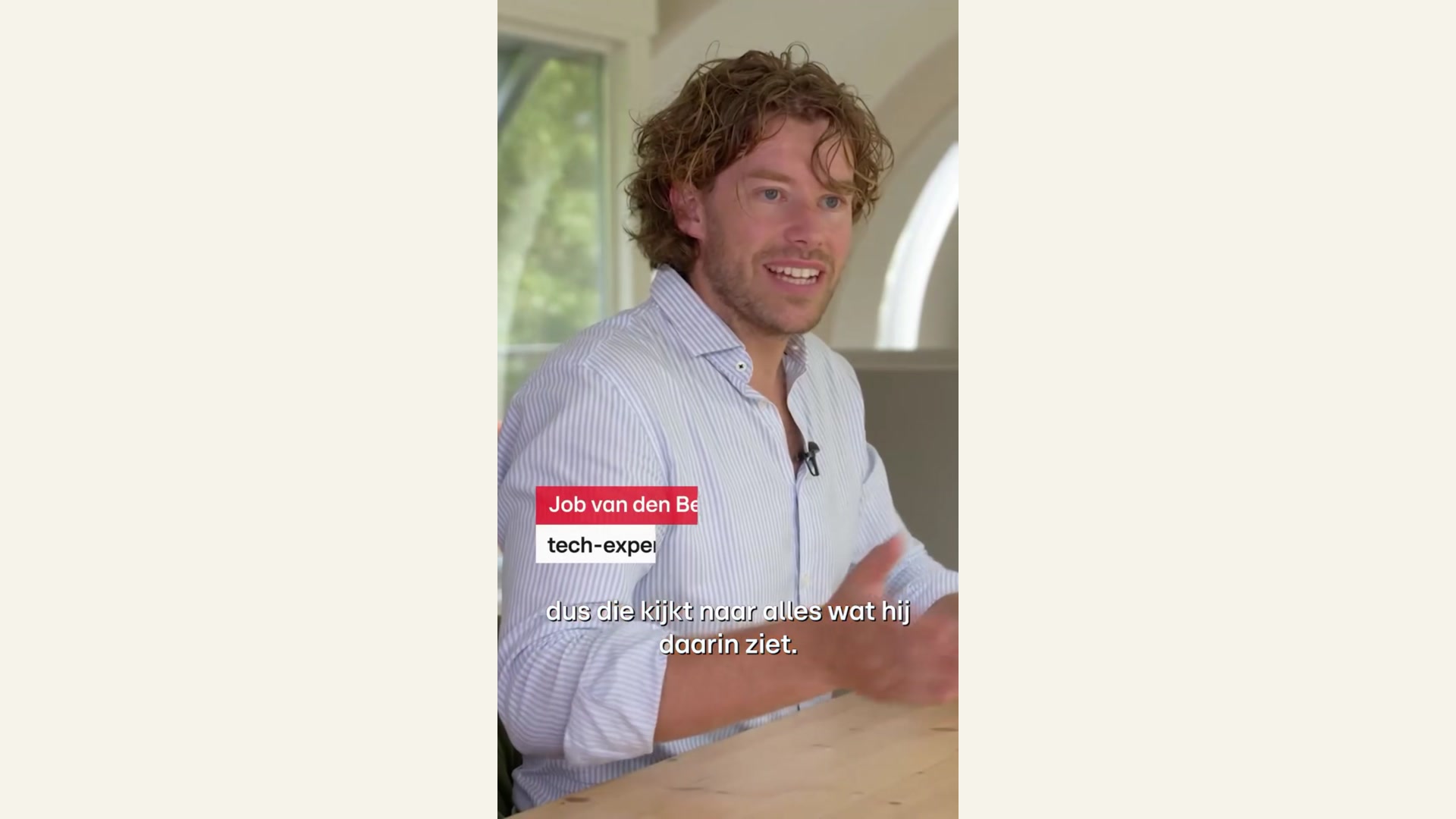
This week, I had the opportunity to explain on EditieNL about a striking piece of clothing: the rainbow camouflage shirt, designed to protect activists from facial recognition cameras. A shirt that makes you invisible to AI – that sounds almost like science fiction. But the technology behind it is surprisingly logical, once you understand how such systems perceive the world. And that's precisely what's interesting: how does a simple shirt confuse an advanced AI system?
AI doesn't see like we do
To understand that, we first need to establish something important: AI models don't look at a human like we do. When you see someone walking down the street, you effortlessly recognise a person. Your brain understands what a human is, even if they're wearing a funny hat, half hidden behind a lamppost, or wearing a brightly coloured jacket. A neural network in a surveillance system works fundamentally differently. It looks at pixels and unique characteristics, at patterns of light, colour, contrast, and form, and makes a prediction based on these. Pure statistics, in other words, about what it sees and who it sees.
During its training, the model has seen millions of images of people and has learned which combinations of features statistically belong to "human." Importantly, the model looks at the overall picture. Not just at your face, but at the entire appearance, the contours of your body, the proportions, the context.
The trick of the shirt
And that's precisely where the trick of this shirt lies. The busy patterns and bright colours disrupt that overall picture. Where the model normally sees a recognisable human form, it now sees a chaos of lines, colours, and contrasts that don't fit what it has learned. The prediction gets confused: is this a human? Something else? Multiple objects? The statistics no longer add up, and recognition fails.
In technical terms, this is called an adversarial attack: you feed the system with input specifically designed to mislead it. It's comparable to an optical illusion, but one that only works on machines. To the human eye, it's just a busy, colourful shirt. To an algorithm, it's noise that makes the entire image unreliable.
To the human eye, it's just a busy shirt. To an algorithm, it's noise that makes the entire image unreliable.
Older than AI itself
The idea, incidentally, is older than AI itself. In the First World War, navies painted their ships with so-called dazzle camouflage: wild, contrasting patterns that didn't make a ship invisible, but made it impossible for the enemy to accurately estimate its speed and course. The rainbow shirt essentially does the same thing, only now the adversary is not a periscope but a camera with a neural network behind it.
Why this only works temporarily
Sounds like an ingenious solution for anyone concerned about surveillance. But there's an important caveat: this is temporary. Because now that we know this shirt exists, and now that it's appearing on television and in the media, AI models are simply being adjusted for it. Developers add precisely these kinds of images to the training data – people in busy, disruptive patterns – and the model learns that those, too, are humans. With that, the disruption loses its power. What works today as a digital invisibility cloak will simply be recognisable clothing in a few model versions.
And there's something else. The shirt is designed to disrupt from a specific perspective, usually from the front. But what if a camera tracks you from the side? Or from above, as many surveillance cameras are positioned? Chances are the model will still correctly predict and recognise you. Furthermore, modern systems don't just look at your clothes or face. There's technology that recognises people by their gait, their posture, their silhouette. One disrupted feature is then not enough to stay out of sight.
Not pointless after all
Does that mean such a shirt is pointless? No, that would be too simplistic. It makes something visible that normally remains invisible: that we are constantly being analysed by systems we know nothing about and have no influence over. The shirt is perhaps primarily a statement, a way to sharpen the conversation about facial recognition and privacy. And that conversation is sorely needed, because technology is developing faster than the legislation surrounding it.
Ultimately, this is a cat-and-mouse game between privacy and technology. Every clever disruption is met with a smarter model, and every smarter model, in turn, provokes new creative countermeasures. The question is not who wins that game, but whether we, as a society, want it to be played. As long as that debate remains unresolved, people will continue to look for ways to evade the algorithmic eye. Even if it's with a rainbow shirt.
Job van den Berg is an AI keynote speaker, tech entrepreneur, and author of five books on AI. He deploys agents himself weekly and gives 150+ keynotes per year on AI agents and agentic commerce.
Counting Cybertrucks in the back seat is not representative research. But it is a perfect example of how statistics, logical thinking, and AI come together: observe, formulate hypotheses, and above all, try to disprove them.
After half a year back in Silicon Valley, one thing stands out: the conversation is shifting from 'what can AI do?' to 'how do we truly build on it?'. Billboards about safe AI, control, and infrastructure indicate a new theme.
Hallucinations can be controlled. Much more difficult is reasoning that sounds logical, is partly supported by research, yet goes further than the evidence permits. On generational differences, statistics, and methodological caution as an AI skill.
The promise of AI agents is friction gone, convenience first. But precisely in that friction, the contact that forges our social capital always arose. An essay on connection, technology, and the default setting.
Job van den Berg is an AI keynote speaker, tech entrepreneur and author of five books on AI. He ships AI agents into production every week and delivers 150+ keynotes a year on AI agents and agentic commerce.
What are open weights and closed-source AI models? Discover the differences and the consequences for costs, privacy, data centers and the AI market.
On EditieNL I discussed whether AI could threaten humanity. About Anthropic researcher Evan Hubinger, agentic AI, the black box, and why we are building faster than we understand.
A simple AI video already costs about 4 litres of water and as much electricity as a 10-watt LED lamp burning for 42 hours. What happens with full films and commercials, and why digital is not automatically sustainable.
AI keeps getting better, yet workplace sentiment about AI is deteriorating. Research shows why adoption is as much a social challenge as a technological one: from the Matthew effect to psychological safety.