Over 12,000 AI tools: what to use and how to start?
Over 12,000 AI tools: what to use and how to start?

Since the introduction of ChatGPT, the number of AI tools has grown exponentially to over 12,000. At the time of writing, hundreds more are being added weekly. This diverse range of tools, varying from Fireflies for capturing meeting minutes to Gamma for presentations and HeyGen for video translations, represents a remarkable advancement in the integration of AI into various aspects of our work.
One of the most notable developments is the integration of generative AI into everyday software such as Outlook, Word, and Excel, with the launch of Microsoft's Copilot and similar initiatives from tech giants like Google. This integration makes daily software smarter and significantly increases efficiency and effectiveness in the workplace.
However, amidst this excitement about the possibilities of AI tools, their limitations also deserve attention. Standard AI tools are often designed for automating specific tasks, such as creating presentations or analysing CVs, and are not necessarily suitable for streamlining entire processes.
Moreover, effective use of these tools often requires a certain degree of technical skill, meaning not all team members can directly benefit without training. Additionally, the tools can sometimes be difficult to integrate into existing workflows, causing them to be quickly overlooked after an initial period of use.
Another important point of consideration is data security. As many of these tools process sensitive information, you must carefully weigh the risks of sharing data with small, unknown companies.
Despite these challenges, AI tools are certainly valuable for individual employees looking to solve specific problems. However, for organisations seeking solutions at a team or organisational level, custom AI integration can often be more effective.
It is therefore advisable to conduct a thorough analysis of how AI can best be deployed within the organisation, taking into account the conditions and its potential impact. This process is extensively described in our new book 'AI Strategy Handbook'.
In short, while standard AI tools can certainly be useful, it is important to use them with due consideration and strive for an integrated approach that aligns with the specific needs of the organisation.
The AI Pyramid: A Practical Approach to AI Implementation
Many leaders and professionals struggle to grasp the enormous impact of AI on their work. Therefore, we recommend breaking down the issue into three digestible chunks:
- For Your Role: Discover how AI can improve your individual work by applying existing AI tools, such as writing better emails or enhancing your communication skills.
- For Your Team: Investigate how AI can improve your team's processes through smart automation and integration into existing work methods.
- For Your Organisation: Think strategically about how AI can transform the organisation, considering the industry, the organisation's position, and customer expectations.
Our advice is to dream big, but start small. By gaining experience and gradually adapting, you can optimally leverage the benefits of AI without radically changing your organisation. Good luck!
- Best AI tools

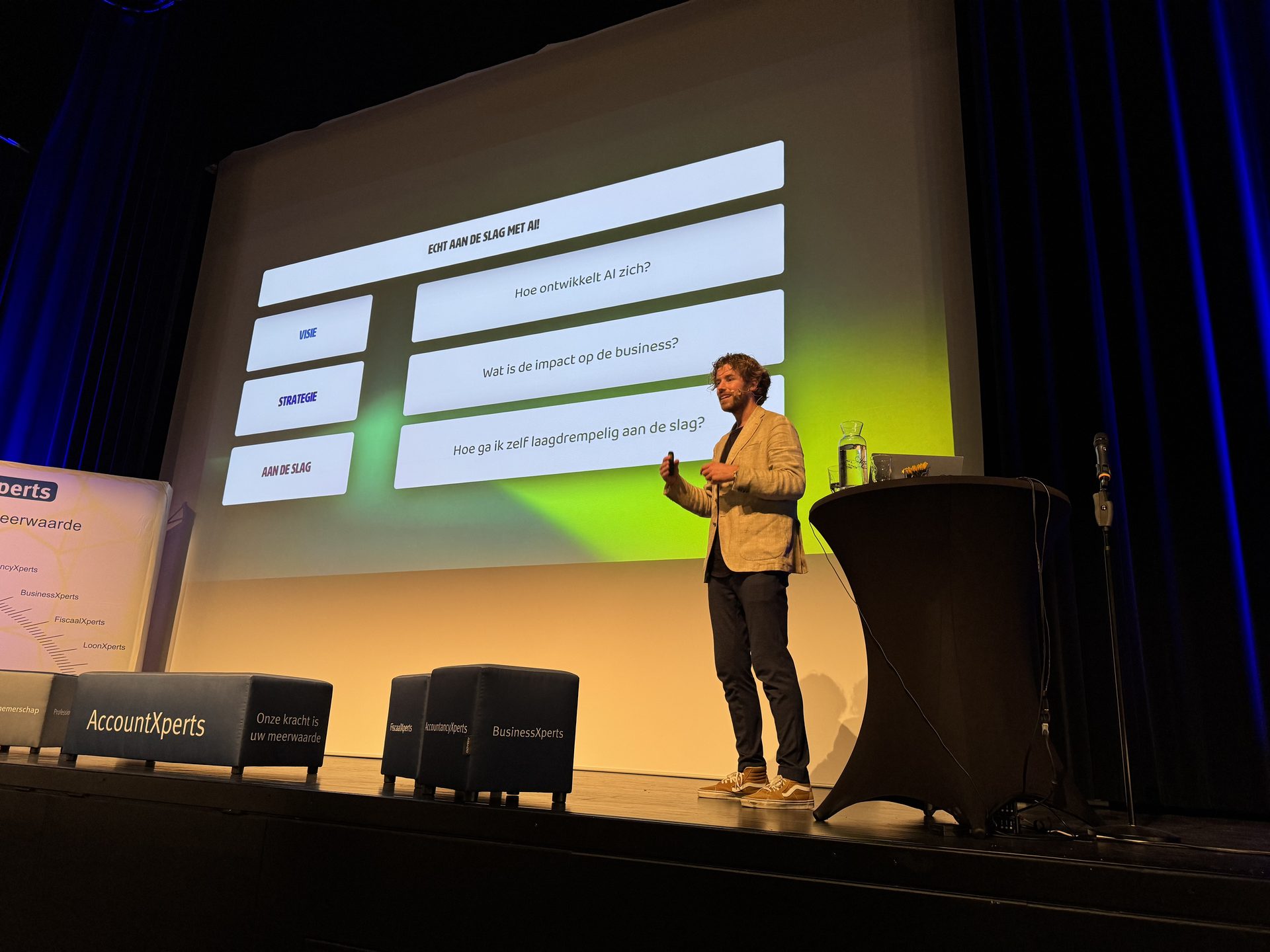
Job van den Berg is an AI keynote speaker, tech entrepreneur and author of five books on AI. He ships AI agents into production every week and delivers 150+ keynotes a year on AI agents and agentic commerce.
What are open weights and closed-source AI models? Discover the differences and the consequences for costs, privacy, data centers and the AI market.
On EditieNL I discussed whether AI could threaten humanity. About Anthropic researcher Evan Hubinger, agentic AI, the black box, and why we are building faster than we understand.
A simple AI video already costs about 4 litres of water and as much electricity as a 10-watt LED lamp burning for 42 hours. What happens with full films and commercials, and why digital is not automatically sustainable.
AI keeps getting better, yet workplace sentiment about AI is deteriorating. Research shows why adoption is as much a social challenge as a technological one: from the Matthew effect to psychological safety.