Not the tool, but the skill: document your ways of working
Stop chasing tools. Start today with documenting skills: ways of working that tell an AI Agent how your organisation operates.

Stop chasing tools. Start today with documenting skills: ways of working that tell an AI Agent how your organisation operates.
There is hardly a week where a new AI tool isn't launched. One promises even smarter texts, the other automates entire workflows. For many organisations, it feels like an unwinnable race: as soon as one tool has been rolled out, the next one is already ready. My advice to every company is therefore as simple as it is urgent: stop chasing tools and start today with documenting skills. These are documented ways of working that tell an AI Agent how your organisation operates.
A skill is the IP of a company. A tool is merely the means.
The hidden costs of tool-thinking
Tools more often lead to polarisation than to progress in the workplace. This may sound contradictory, as new technology should connect and accelerate. In practice, often the opposite happens.
As soon as an organisation embraces one tool, the nagging feeling of falling behind quickly arises, because a newer, better version is already on the market. And then there's that one enthusiastic colleague who has already tried everything, shows a new demo in every meeting, and effortlessly scatters jargon. Well-intentioned, but unintentionally a dichotomy arises: an in-group of early adopters and an out-group of colleagues who drop out. Who belongs and who doesn't.
The result? Energy that should go to work leaks away into tool discussions, licence comparisons, and mutual frustration. The question "which tool do we use?" overshadows the much more important question: how do we actually work, and how do we document that?
What exactly is a skill?
A skill is a documented way of working that an AI Agent or a new colleague can apply directly. In practice, it is a file that you share with an AI, giving it unique knowledge specific to and about the organisation. Not generic best practices from the internet, but the way *this* company works.
A good skill documents four things.
The steps
How is this task approached, and in what order? What comes first, what follows, and where are the dependencies?
The checks
What is checked before something is released? What are the quality requirements, and when is something good enough?
The output
What does a good result look like? In what format is it delivered, and what style guide or tone must it meet?
The context
What knowledge, procedures, and rules belong to it? Internal agreements, terminology, customer agreements, and unwritten rules.
Anyone who writes these four things down for four different tasks has, in fact, the beginning of a living manual. But one that an AI Agent can execute directly.
The big advantage: skills are tool-independent
Herein lies the crux. Skills are not tied to one specific tool or vendor. Most modern AI tools can work with them. Will a new, better tool come onto the market next year? Fine. The skills simply move along.
This means that an organisation builds knowledge that remains its *own*, not that of the software vendor. No vendor lock-in, no knowledge that evaporates as soon as a contract expires or a platform disappears. The investment is in documenting the way of working, and that investment is sustainable.
And the beauty of it: as soon as an agent loads a skill, it suddenly knows exactly how the organisation works. Which steps are involved, which quality requirements apply, what the end result should look like. Instant expertise, without months of onboarding.
What it delivers concretely
Impact. Everyone, human and AI Agent, works according to the same proven approach. No ten variants of the same process, but one documented way of working that has already proven itself.
Independence. No vendor lock-in. The knowledge is in the skills, not in the tool. Changing suppliers becomes a practical choice instead of a painful operation.
Innovation. Energy goes into working better instead of into tool discussions. Teams talk about improving the way of working itself. And *that* is where real progress lies.
The most significant gain: knowledge becomes everyone's
Perhaps the biggest advantage is this: skills ensure that a company's knowledge and expertise become widely accessible. The expertise that currently resides in the heads of a few experienced colleagues is documented, shareable, and directly applicable. For new employees and for AI Agents.
This also eliminates the dichotomy between the digital vanguard and the rest. It is not proficiency with the latest tool that determines who participates, but the shared way of working to which everyone contributes. This creates impact and encourages innovation instead of hindering it.
Start today, and start small
Documenting skills doesn't have to be a big project. Choose one recurring task, such as drafting a quotation, creating a monthly report, or handling a customer query. Describe the steps, the checks, the output, and the context. Test that skill with an AI Agent, refine where necessary, and share the result with the team.
Anyone who starts with one skill today will have a library of documented ways of working in a year. And with that, an advantage that no tool can offer. Because tools come and go. The way of working, *that* is the real capital of an organisation.
Job van den Berg is an AI keynote speaker, tech entrepreneur, and author of five books on AI. He puts agents into production himself weekly and gives 150+ keynotes per year on AI agents and agentic commerce.
Counting Cybertrucks in the back seat is not representative research. But it is a perfect example of how statistics, logical thinking, and AI come together: observe, formulate hypotheses, and above all, try to disprove them.
After half a year back in Silicon Valley, one thing stands out: the conversation is shifting from 'what can AI do?' to 'how do we truly build on it?'. Billboards about safe AI, control, and infrastructure show a new theme.
Hallucinations can be controlled. Much more difficult is reasoning that sounds logical, is partly supported by research, yet goes further than the evidence permits. On generational differences, statistics, and methodological caution as an AI skill.
The promise of AI agents is friction gone, ease first. But precisely in that friction, the contact that forged our social capital always arose. An essay on connection, technology, and the default setting.
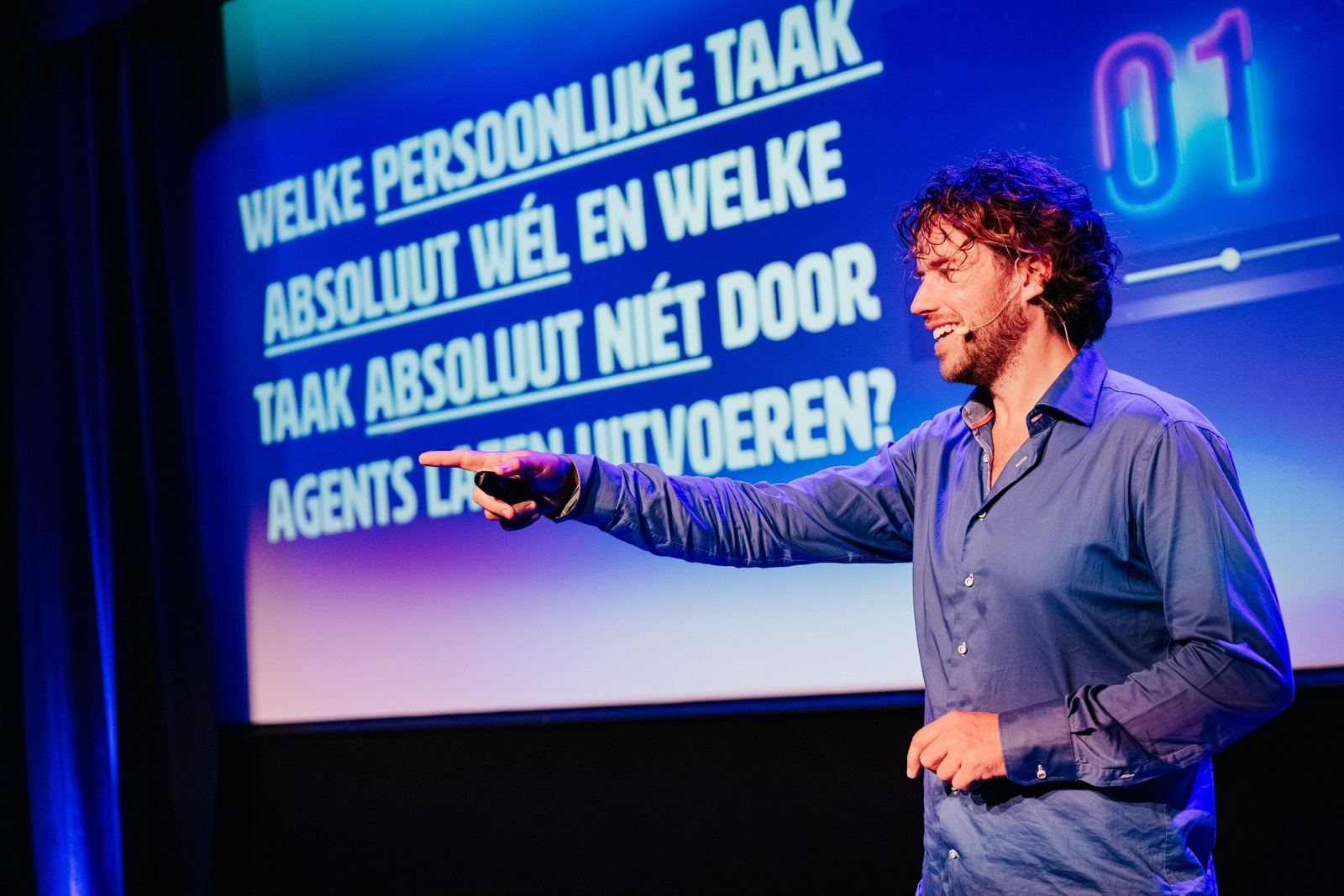

Job van den Berg is an AI keynote speaker, tech entrepreneur and author of five books on AI. He ships AI agents into production every week and delivers 150+ keynotes a year on AI agents and agentic commerce.
What are open weights and closed-source AI models? Discover the differences and the consequences for costs, privacy, data centers and the AI market.
On EditieNL I discussed whether AI could threaten humanity. About Anthropic researcher Evan Hubinger, agentic AI, the black box, and why we are building faster than we understand.
A simple AI video already costs about 4 litres of water and as much electricity as a 10-watt LED lamp burning for 42 hours. What happens with full films and commercials, and why digital is not automatically sustainable.
AI keeps getting better, yet workplace sentiment about AI is deteriorating. Research shows why adoption is as much a social challenge as a technological one: from the Matthew effect to psychological safety.