Should we ban AI in the classroom, embrace it, or adapt our education system?
It's a question we've heard more and more frequently over recent months from school leaders, administrators, and teachers: "What should we do with AI in education?" Should we ban it, embrace it, or fundamentally adapt our education to it?

It's not a new fear. In the 1960s, maths teachers took to the streets to protest against the calculator. They feared that students would no longer learn mental arithmetic, and that their profession would become obsolete.
We now know how that turned out: the calculator didn't make the teacher less relevant, but rather more important. And that history is repeating itself now, only today's calculator is called AI.
1. Knowledge remains the foundation, especially in an AI era
There's a persistent misconception that AI makes knowledge redundant. Why bother learning if ChatGPT can provide every answer?
But anyone who works with AI knows the opposite is true. AI generates language based on probability, not on understanding. Without your own knowledge, you cannot judge whether an answer is correct, logical, or contextually appropriate.
Scientific studies demonstrate this. In experiments where inexperienced individuals used AI for complex tasks – such as drafting contracts or building websites – the results often led to errors and inaccuracies. Participants with subject-matter expertise, on the other hand, produced much better output with the help of AI.
So, knowledge isn't a burden, but fuel. AI doesn't make knowledge obsolete; it strengthens its value.
2. New skills will become decisive
According to research by the World Bank, the most important skills of the future are shifting towards:
- Critical thinking skills
- Adaptability
- Empathy
This is no coincidence. As AI takes over more and more cognitive work, human judgment becomes all the more crucial.
Education must therefore not only teach students how to use AI, but primarily how to think about it. How do you recognise bias in a text? How do you assess if a source is correct? How do you build upon an idea generated by AI?
In other words: we need to teach students to reflect on knowledge, not just reproduce it.
We are moving from knowing → to understanding → to questioning. And that demands a different teaching approach, where technology is a tool, but human thought remains the starting point.
3. AI as an amplifier of human potential
AI is not a threat, but a powerful amplifier of human potential.
Recent research in Nigeria focused on AI homework assistance. Students who received help with their assignments via ChatGPT developed their skills six times faster than the control group. Not because the technology did the work for them, but because they received immediate feedback, explanations, and encouragement.
AI also offers enormous opportunities for teachers. It can assist with lesson preparation, generating examples, or adapting explanations to a student's level. Teachers can use AI as a didactic sparring partner – a tool that supports, inspires, and frees up time for what education is truly about: personal attention, curiosity, and growth.
Or, as an artist recently demonstrated by bringing historical paintings to life with AI: technology can enhance stories, not replace them.
Learn, unlearn, and relearn
The well-known futurist Alvin Toffler once said:
“The illiterate of the future will not be those who cannot read or write, but those who cannot learn, unlearn and relearn.”
That statement is more relevant today than ever. The future of education lies not in avoiding technology, but in learning how technology can work for us.
The challenge for education is therefore not whether we use AI, but how we deploy it in a responsible, human, and valuable way.
AI challenges us to reinvent education – not by abolishing knowledge, but by deepening learning.
Watch this video back, which we recorded on behalf of the VO-raad:
- Best AI tools
- GEO: discoverable in AI search engines
- Writing AI prompts

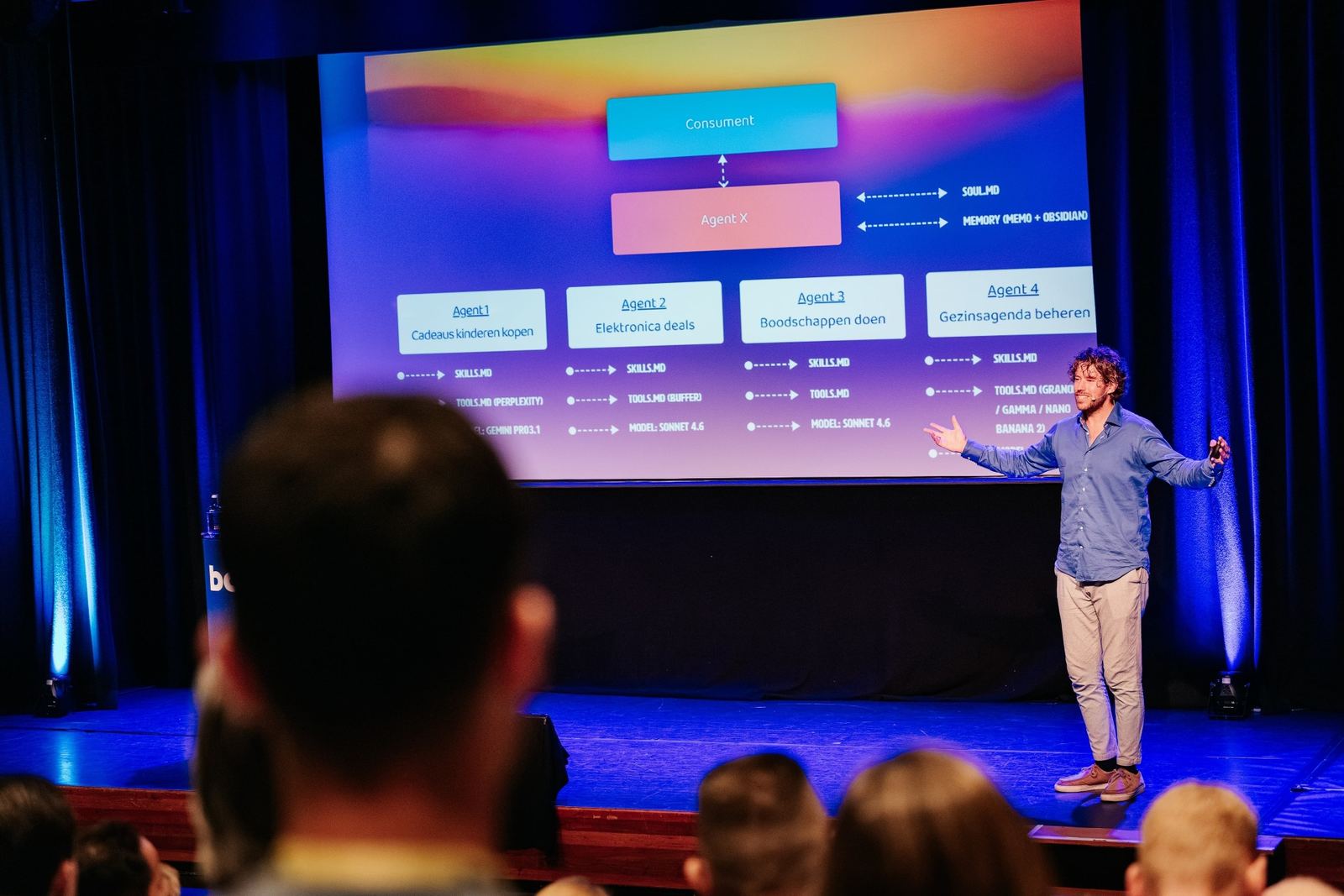
Job van den Berg is an AI keynote speaker, tech entrepreneur and author of five books on AI. He ships AI agents into production every week and delivers 150+ keynotes a year on AI agents and agentic commerce.
What are open weights and closed-source AI models? Discover the differences and the consequences for costs, privacy, data centers and the AI market.
On EditieNL I discussed whether AI could threaten humanity. About Anthropic researcher Evan Hubinger, agentic AI, the black box, and why we are building faster than we understand.
A simple AI video already costs about 4 litres of water and as much electricity as a 10-watt LED lamp burning for 42 hours. What happens with full films and commercials, and why digital is not automatically sustainable.
AI keeps getting better, yet workplace sentiment about AI is deteriorating. Research shows why adoption is as much a social challenge as a technological one: from the Matthew effect to psychological safety.