Generative AI primarily changes the content of work
New paper by Wang et al. (2026) analyses 9.37 million US job postings. The main conclusion: AI reorganises jobs rather than replacing them, task by task, function by function.

The paper Generative AI and the Reorganization of Labor Demand by Wang et al. (2026) looks beyond the classic question often asked when discussing AI and work: which jobs will disappear and which new jobs will emerge? This is, of course, a relevant question, but also a limited one. The labour market doesn't just change because roles disappear or new roles emerge. A significant part of the change takes place within existing roles. And it is precisely this that makes the impact of generative AI so important and yet so difficult to pinpoint.
The researchers analysed US online job postings from January 2021 to June 2025. The raw dataset contained over 188 million job postings. For the final analysis, a sample of more than 9.37 million job postings was used. This provides a sharp picture of how employers are adapting their demand for labour since the rapid rise of generative AI.
The main conclusion is that companies are not simply eliminating "AI-sensitive jobs." The picture is more nuanced. Employers are reorganising their labour demand in two ways. On the one hand, the type of job postings being advertised is changing. Certain roles are becoming less sought after, while other roles are becoming more important. On the other hand, the content of existing roles is being adjusted. And it is precisely this second effect that shows what AI is truly doing to work.
Because a role can retain the same title, while the content of the work fundamentally changes. A marketer might still be called a marketer. But the daily work shifts. Less time is spent on executive copywriting, manually creating variations, or drafting initial concepts. More time is dedicated to strategy, brand positioning, campaign analysis, quality control, and intelligently directing AI tools. The job title therefore remains recognisable, but the underlying tasks change.
This applies not only to marketing. The same pattern is visible in roles such as consultancy, communications, HR, finance, legal, software development, and customer service. The name of the role often remains the same, but the balance between tasks changes. Tasks that are easily automated or supported by AI become smaller. Tasks where human judgment, contextual understanding, creativity, responsibility, and collaboration are central, become more important.
This makes the impact of AI on the labour market harder to discern than often thought. It is common to look for clear signals: fewer vacancies for role A, more vacancies for role B, or entirely new job titles such as AI specialist, prompt engineer, or AI product manager. But a large part of the change is happening beneath the surface. Not in the job title, but in the daily work itself.
AI changes work task by task, function by function, and organisation by organisation. Sometimes this is very visible, for example, when an organisation decides to fully automate a process. But much more often, it is gradual. An employee uses AI to quickly arrive at an initial analysis. A team lets AI create concept texts. A department uses AI to structure customer queries. A manager uses AI to prepare scenarios. Individually, these seem like small changes. Together, they lead to a fundamental reorganisation of work.
Precisely for this reason, it is insufficient to only look at job titles or the number of vacancies. Anyone who only counts how many jobs are added or disappear misses a large part of the real transformation. The labour market is changing primarily from within. The real shift is less about which jobs exist than about what people actually do within those jobs.
This also has major implications for organisations. If roles change in content, organisations must rethink job profiles, training, leadership, and career development. Which tasks remain with people? Which tasks are supported by AI? Which new skills become important? And how do organisations ensure that employees truly understand AI and use it well, critically, and responsibly?
For employees, this means that the value of a role lies less and less in performing standard tasks and more and more in being able to combine substantive expertise, critical thinking, and the ability to effectively use technology. The question is not just: can AI do part of the work? The better question is: how does AI change the composition of the work, and which tasks therefore become more important?
Generative AI therefore primarily changes the labour market by reorganising work, rather than replacing it. This may be less spectacular than the image of mass job disappearance, but it is at least as profound. Because if the content of roles changes, eventually what organisations demand from people also changes.
Anyone who truly wants to understand the impact of AI on work should therefore look at tasks instead of jobs. At work processes instead of job titles. And especially at what is shifting, not just what is disappearing.
- Best AI Tools
- GEO: discoverable in AI search engines
- Writing AI prompts

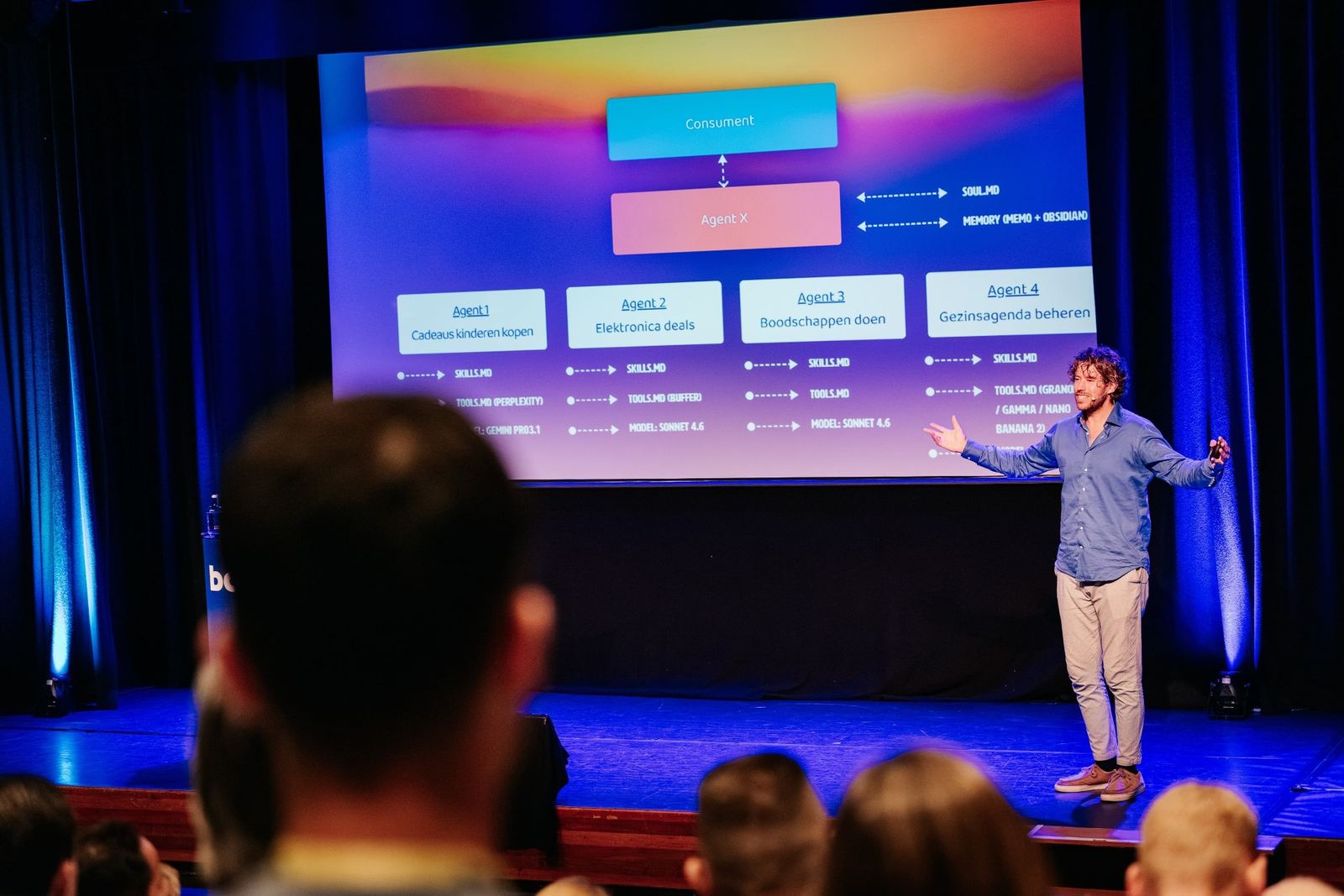
Job van den Berg is an AI keynote speaker, tech entrepreneur and author of five books on AI. He ships AI agents into production every week and delivers 150+ keynotes a year on AI agents and agentic commerce.
What are open weights and closed-source AI models? Discover the differences and the consequences for costs, privacy, data centers and the AI market.
On EditieNL I discussed whether AI could threaten humanity. About Anthropic researcher Evan Hubinger, agentic AI, the black box, and why we are building faster than we understand.
A simple AI video already costs about 4 litres of water and as much electricity as a 10-watt LED lamp burning for 42 hours. What happens with full films and commercials, and why digital is not automatically sustainable.
AI keeps getting better, yet workplace sentiment about AI is deteriorating. Research shows why adoption is as much a social challenge as a technological one: from the Matthew effect to psychological safety.