The new definition of intelligence in the age of AI Agents
Why emotional intelligence will soon become more important than analytical speed, and what that means for professionals and organisations.

Three years ago, the question "what exactly is AI?" was still mostly something for stages and panel discussions. I remember those conversations well, because almost every keynote started the same way. Whether I was speaking myself or sitting in the audience, we'd bring up Turing, talk about neural networks, and usually conclude that no one knew exactly where intelligence began and automation ended. Ultimately, we solved it practically: if it seemed smart enough and delivered value, we just called it AI. With that, the discussion temporarily receded into the background.
Until now.
Because by now, AI is transforming from a tool into an executor. In more and more organisations, I see the same pattern emerging, not as a future vision but as a concrete reality. Customer queries are handled by agents, reports are automatically compiled, and analyses, planning, and first-line decisions are rapidly shifting towards systems that perform tasks autonomously. Precisely because of this, that old question returns, but no longer as a philosophical discussion, but as a practical question that organisations and professionals must now answer: what does intelligence still mean when machines take over most of the operational thinking?
Because if I'm honest, that's starting to get uncomfortably close. For years, we largely equated intelligence with analytical ability: quickly processing information, overseeing complex situations, making connections, and possessing extensive knowledge. That's what professionals, including myself, were judged on. However, AI Agents are now doing precisely that faster, more consistently, and more cheaply. And then a confronting reality emerges, because if we continue to define intelligence as purely analytical firepower, we are directly competing with systems that are becoming increasingly better at it. Anyone who still fully links intelligence to information processing is slowly defining themselves out of the market.
What I see happening is that the value of human intelligence is shifting. Not disappearing, but moving to another domain: the emotional and relational domain. That may sound softer than intended, but it is precisely there that the strongest distinctive power will emerge in the coming years. As agents take over operational work, space is created for something else: conversations, trust, nuance, leadership, and situations where, besides data, timing, empathy, and context also matter.
You don't convince a hesitant customer with information alone, and you don't resolve a team conflict with an analysis. A tense negotiation rarely revolves purely around rationality, and a difficult decision sometimes requires intuition, even when the data doesn't provide a clear answer. This kind of work is much harder to automate, not because AI is stupid, but because human interaction is rarely entirely logical or predictable.
That's why I think we increasingly need to see intelligence as two different forms. Machine intelligence is instrumental in nature and excels in speed, scale, analysis, and execution. It doesn't get tired, has no ego, and isn't distracted by emotions or context. Human intelligence, on the other hand, shifts towards something else: creating meaning, building relationships, sensing tensions, and forming judgments in situations where perfect data is not available. Not as competitors to each other, but as complements.
However, I still see many organisations thinking in terms of replacement, as if it's a competition between humans and machines. But that's the wrong discussion. The real question is not who is better, but what type of intelligence adds the most value where. And therein lies the strategic challenge.
Because the organisations that will win in the future probably won't necessarily have the best agents. That technology will quickly become available to everyone, meaning the difference will lie much more in how organisations position their people alongside that technology. Smart organisations automate everything that is predictable and operational, so that people can focus on what remains human: customer relationships, leadership, trust, guiding change, and having difficult conversations.
This also demands something uncomfortable from professionals. Many of us have invested for years in instrumental skills: learning new tools, becoming more analytical, working faster, and building more knowledge. But are we investing just as consciously in the other side? In listening better, having difficult conversations, empathy, persuasiveness, and recognising what's happening beneath the surface in a team? Because that's precisely where the difference will lie. Not because technical skills will disappear, but because they will increasingly become a prerequisite rather than a distinctive capability.
The question for the coming years is therefore no longer: "what is AI?" We have practically lost that discussion to reality. The real question has become much more personal: what remains uniquely human when AI takes over most of the executive thinking? And are we actually investing enough in that?
Want to get started with AI yourself? Check out our e-learning AI Agents or AI workshops for teams.
Getting started with AI Agents
Ready to implement agentic AI yourself? Discover how we build agents at ai.nl/ai-agents, train your team with the AI Agents training, or get started yourself with our e-learning AI Agents. For inspiration at board level: book an AI keynote.
- Best AI tools
- GEO: discoverable in AI search engines
- Writing AI prompts

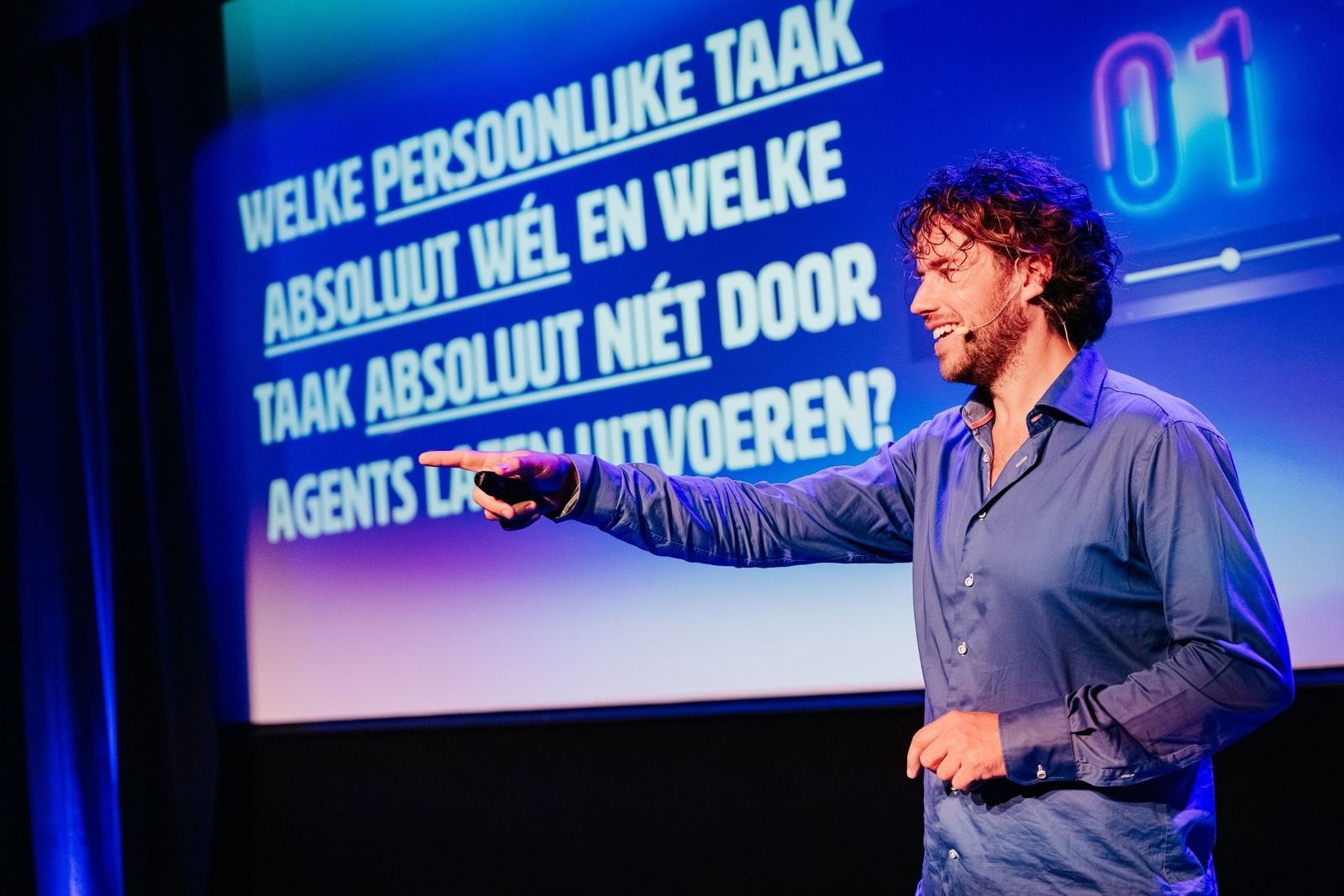
Job van den Berg is an AI keynote speaker, tech entrepreneur and author of five books on AI. He ships AI agents into production every week and delivers 150+ keynotes a year on AI agents and agentic commerce.
What are open weights and closed-source AI models? Discover the differences and the consequences for costs, privacy, data centers and the AI market.
On EditieNL I discussed whether AI could threaten humanity. About Anthropic researcher Evan Hubinger, agentic AI, the black box, and why we are building faster than we understand.
A simple AI video already costs about 4 litres of water and as much electricity as a 10-watt LED lamp burning for 42 hours. What happens with full films and commercials, and why digital is not automatically sustainable.
AI keeps getting better, yet workplace sentiment about AI is deteriorating. Research shows why adoption is as much a social challenge as a technological one: from the Matthew effect to psychological safety.