The Chinese Innovation Wave: fascinating, astounding, and confronting
Developments in China are progressing at a pace that many find almost impossible to keep up with. While Western countries are still contemplating ethics, regulations, and implementation, China appears to be a step ahead. Whether it's artificial intelligence, automation, digital payment methods, facial recognition, or smart cities, the speed and scale at which technology is deployed there are truly impressive.

Recently, we travelled through China. We visited more than 10 tech companies in Shanghai, Shenzhen, and Guangzhou (including Tencent, Huawei, GAC, Meituan, UbTech, Poizon, and SenseTime). In this article, we share our insights and experiences from this trip. Because developments in China are progressing at a pace that many find almost impossible to keep up with. While Western countries are still contemplating ethics, regulations, and implementation, China appears to be a step ahead. Whether it's artificial intelligence, automation, digital payment methods, facial recognition, or smart cities, the speed and scale at which technology is deployed there are truly impressive.
For those observing, the initial reaction is often a mix of astonishment and confusion. How is this possible? What is happening there? And how can we as an organisation ever keep up at this pace? But this wonder doesn't have to descend into a feeling of being left behind or fear. In fact, perhaps it's time to shift perspective.
What if we don't try to keep up, but instead learn to observe? Not to copy, but to be inspired?
What we can learn from China
China has grown into a global innovation engine. In many sectors, technology is not merely a tool but the driving force of economic and social development. Companies like Alibaba, Tencent, Huawei, and numerous lesser-known players experiment, launch, test, and scale at a rapid pace. The way they integrate user feedback, connect systems, and create new revenue models is sometimes astoundingly effective.
For companies in Europe, this presents an opportunity. Not to do the same things, but to look with a curious eye:
- How do they accelerate their innovation cycles?
- What role does technology play in their daily processes and customer interactions?
- What solutions do they offer for complex logistical, administrative, or social issues?
- How do they use data, AI, and automation to make smarter choices?
China shows what is possible when technology is not an expense but a strategic core component of your operations. When you dare to experiment and see failure as a learning opportunity. When you see scale and speed not as obstacles, but as a flywheel. But precisely because China is so fascinating, it's important to also consider what is happening beneath the surface. Because not everything that appears fast and technologically advanced is desirable, let alone imitable. Moreover, the way of doing business is often fundamentally different. And while labour efficiency and production capacity are impressive, they are sometimes offset by intensive workloads and inadequate labour rights. In short: there is much we can observe with an open mind, but at least as much that we consciously should not adopt. Because technological power without a moral compass is not progress, but a risk.
The power of critical observation
That's why it's so important for companies in Europe to look at what's happening in China with admiration, yet also with nuance. Not to belittle ourselves, but to realise what our unique strength is: innovating with values. With an eye for humanity, ethics, sustainability, and societal impact.
What China shows us is that we may dare to move a bit faster. We may experiment more, rely more on data and technology as a growth engine. But it also shows us that we must not abandon our core principles in doing so. That speed isn't everything, and that responsibility, transparency, and individual rights are just as much innovative forces.
A mirror and a source of inspiration
China is not a blueprint. It is a mirror. A mirror that shows how fast things can go, how grand ideas are conceived, but also how important it is to ask yourself: What do we stand for? What is our own direction?
It is up to us to use that mirror to see more clearly. Not to fear technology, but to embrace it, in our own way. In a way that suits who we are and where we want to go.
Not to keep up, but to provide direction. Not to copy, but to choose consciously.
- Beste AI-tools
- GEO: vindbaar in AI-zoekmachines
- AI-prompts schrijven

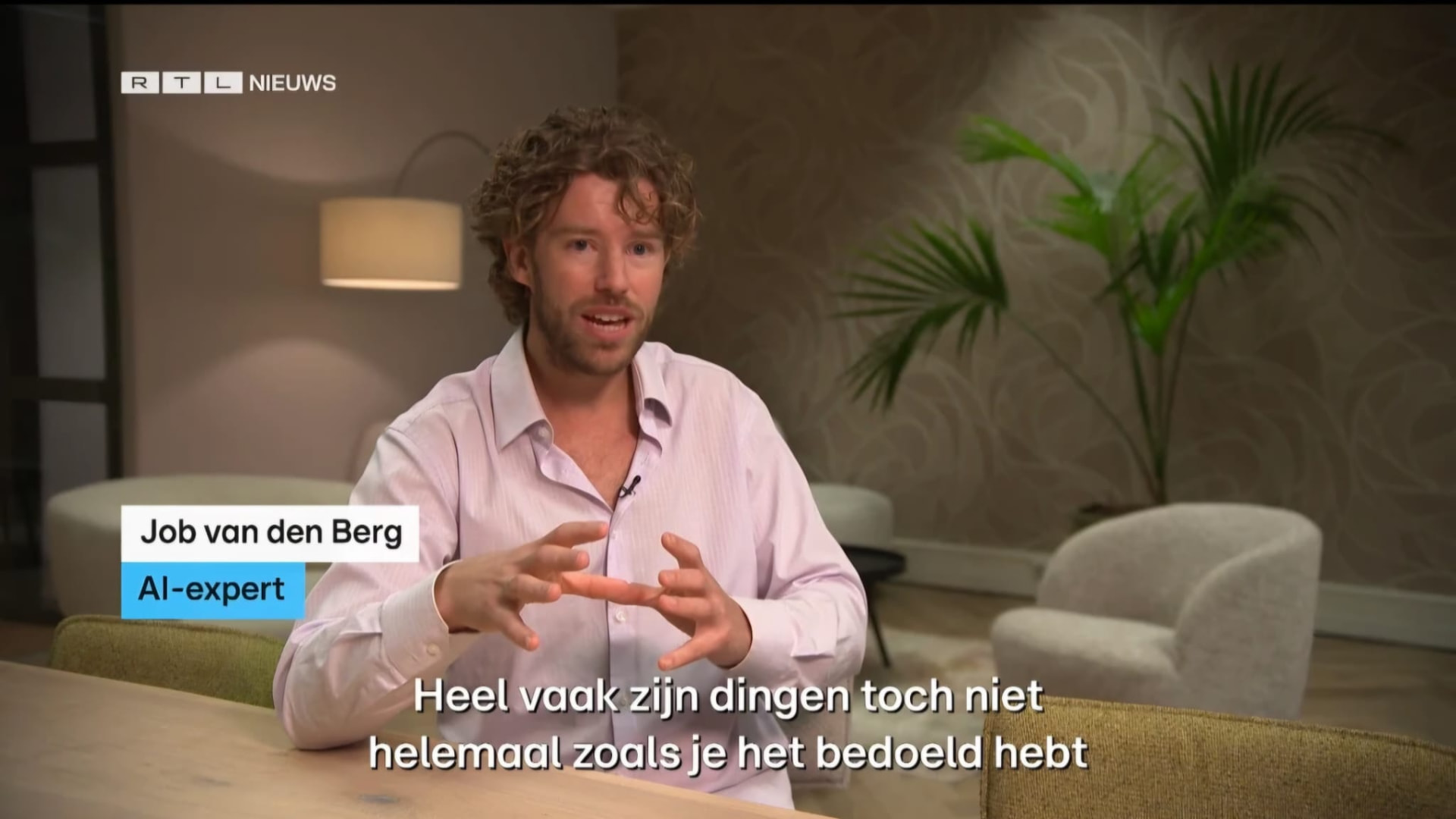
Job van den Berg is an AI keynote speaker, tech entrepreneur and author of five books on AI. He ships AI agents into production every week and delivers 150+ keynotes a year on AI agents and agentic commerce.
What are open weights and closed-source AI models? Discover the differences and the consequences for costs, privacy, data centers and the AI market.
On EditieNL I discussed whether AI could threaten humanity. About Anthropic researcher Evan Hubinger, agentic AI, the black box, and why we are building faster than we understand.
A simple AI video already costs about 4 litres of water and as much electricity as a 10-watt LED lamp burning for 42 hours. What happens with full films and commercials, and why digital is not automatically sustainable.
AI keeps getting better, yet workplace sentiment about AI is deteriorating. Research shows why adoption is as much a social challenge as a technological one: from the Matthew effect to psychological safety.