AI agents in the workplace: how to deal with fears and resistance?
In this article, we highlight how AI agents are changing the workplace and what (often underlying) fears arise at different levels within an organisation. By understanding and acknowledging these fears, you can better manage and guide the implementation of AI within your organisation.

The rise of AI agents promises enormous changes for the way we work. From automated customer service and smart data analysis to entirely new business models: artificial intelligence is an indispensable part of the business world. While this technological progress offers many opportunities, it also evokes resistance and fear. This resistance is perfectly human, because every change, whether it concerns lease policies, a new office, or the reorganisation of departments, brings uncertainty.
In this article, we highlight how AI agents are changing the workplace and what (often underlying) fears arise at different levels within an organisation. By understanding and acknowledging these fears, you can better manage and guide the implementation of AI within your organisation.
Change as a constant source of fear
Whether it's small or large innovations: change is exciting for most people. We often stick to our familiar routine and find it difficult when it is disrupted. With the introduction of AI agents, this resistance can be particularly strong because artificial intelligence is an abstract phenomenon that is not always tangible or understandable. This can lead to feelings of uncertainty, concerns about competencies, or even fear of job loss.
Therefore, when introducing AI agents into an organisation, it is wise to consider in advance the fundamental fears that exist at the different organisational levels. By understanding what is happening with management, middle management, and employees, you can choose the right strategy to involve everyone in the change process.
Three levels, three fears
1. Management: fear of (risky) innovation
Management teams often face the challenge of innovating while also remaining responsible for the organisation's continuity and profitability. Innovation comes with risks: new technologies require investment and deviating from established paths. It can happen that revenue (temporarily) declines or that objectives are not immediately met. These potential setbacks sometimes cause management to hesitate to really push through with AI applications.
Tip: Make the risks and potential returns of AI transparent. A clear business case with measurable objectives and a step-by-step approach helps convince management of the value and feasibility of AI innovations.
2. Middle management: fear of team downsizing
Middle managers sit between management and employees. Their success is often measured by the performance and size of their team. When AI agents take over tasks, it can mean that there is less need for certain roles. This may lead to smaller teams, which can create uncertainty about their status and impact within the organisation.
Tip: Emphasise that in addition to automation, AI also creates new opportunities. Explain that roles can change and there will be room for other, often more strategic or creative tasks within the team. This gives middle managers confidence that their role and their team will remain relevant.
3. Employees: fear of job loss
Employees who perform daily operational tasks are often afraid that AI agents will 'take over their jobs'. They fear losing their job security or running the risk that their role will no longer be relevant. This fear can manifest as resistance, reluctance, or even open criticism of AI projects.
Tip: Offer transparency and support. Show that AI can also help with dull, repetitive tasks, thereby creating space for tasks with more added value. Training, coaching, and reskilling or upskilling are essential to give employees the feeling that they are growing with the organisation and will not be sidelined.
How do you deal with resistance and fears?
- Keep communicating: Keep all levels of the organisation constantly informed of plans, progress, and results. Clear and honest communication removes uncertainties and builds trust.
- Involve people in the process: Give teams a voice and let them contribute to the implementation of AI. This creates buy-in and increases the chance of successful integration of AI into daily practice.
- Foster a learning culture: Offer training and workshops so that everyone can build knowledge about AI. This helps employees develop their skills and increases their sense of competence and relevance.
- Start small, scale up: Begin with a pilot or a specific AI project to demonstrate the benefits on a small scale. If that goes well, confidence will increase, and you can scale up more easily.
AI agents will profoundly change the workplace in the coming years. The fears that arise at management level, among middle managers, and among employees are very understandable. By recognising that each level has its own concerns, from declining revenue to team downsizing and job loss, you can specifically address these needs and uncertainties.
Change does not always have to be painful if you acknowledge and address the underlying fears. A transparent approach, a clear vision, and providing opportunities for (re)training can make AI a driver for positive, sustainable growth within any organisation. This way, you ensure that management, middle management, and employees can all look forward to the future with confidence, with AI as a valuable partner.
- Concerns about AI

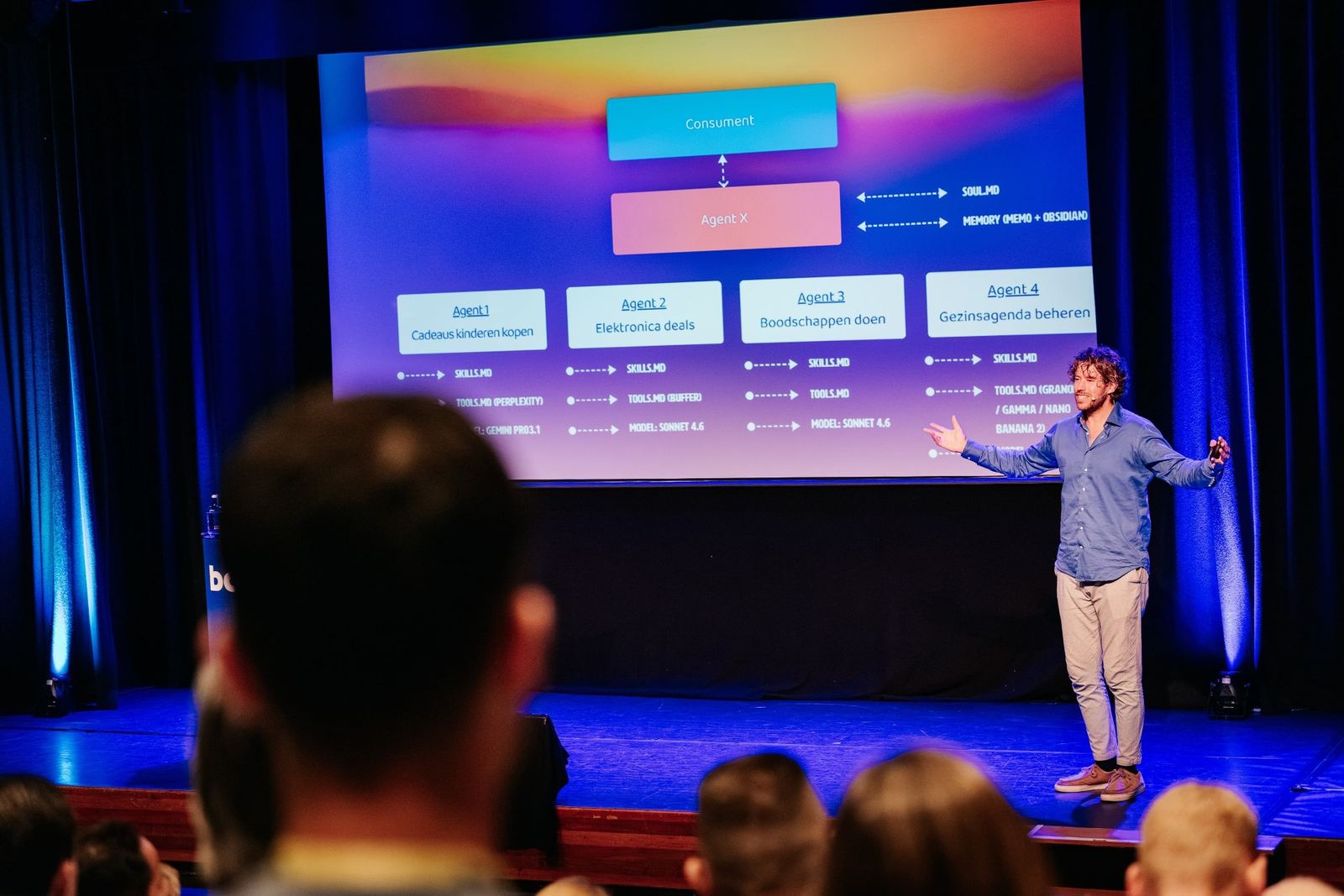
Job van den Berg is an AI keynote speaker, tech entrepreneur and author of five books on AI. He ships AI agents into production every week and delivers 150+ keynotes a year on AI agents and agentic commerce.
What are open weights and closed-source AI models? Discover the differences and the consequences for costs, privacy, data centers and the AI market.
On EditieNL I discussed whether AI could threaten humanity. About Anthropic researcher Evan Hubinger, agentic AI, the black box, and why we are building faster than we understand.
A simple AI video already costs about 4 litres of water and as much electricity as a 10-watt LED lamp burning for 42 hours. What happens with full films and commercials, and why digital is not automatically sustainable.
AI keeps getting better, yet workplace sentiment about AI is deteriorating. Research shows why adoption is as much a social challenge as a technological one: from the Matthew effect to psychological safety.