AI agents and Generative AI go beyond taking over repetitive tasks
AI agents go much further than simple task automation and touch the core of how we organise companies and design processes. In this article, we look at the fundamental changes that AI agents are bringing about and why you should start working with them now.

AI agents and generative AI are now indispensable in the business world. Increasingly, you read that these technologies can take over 'boring' and repetitive tasks. And that's true. But anyone who thinks it stops there underestimates the true impact of this development. AI agents go much further than simple task automation and touch the core of how we organise companies and design processes. In this article, we look at the fundamental changes that AI agents are bringing about and why you should start working with them now.
From automation to transformation
Many people still consider AI an extension of existing automation, aimed at making repetitive tasks more efficient. Of course, this is an important step: generative AI can process large amounts of data, generate emails, or take over routine actions in a very short time. But AI agents go beyond that. They can perform cognitive tasks previously reserved for humans, such as assessing situations, making decisions, and independently executing complex workflows.
This means that the way we design processes and organise work can change completely. We are no longer talking about simple 'task optimisation', but about the fundamental transformation of business models and organisational structures.
Read also: The "Kasparov Syndrome": what if AI does your job better than you?
Process mining as a starting point
Before you can deploy AI agents, you need to thoroughly map out your processes. Process mining is the ideal method for this. It provides insight into:
- What processes exactly exist within your organisation.
- Who is involved in these processes and what responsibilities they bear.
- What data is needed for the process (and AI) to run smoothly.
- What technology is already in place and how it can integrate with AI.
Only when you know where the bottlenecks, opportunities, and dependencies lie can you deploy AI agents in a targeted manner. Often, it will turn out that more is possible than you initially thought. A process you previously labelled 'boring' and 'repetitive', for example, might be part of a larger, strategic interest.
AI agents in your process: re-evaluation of approach
AI agents have the potential to completely take over or radically restructure certain process steps. Where traditional software tools often still require human intervention, AI agents can:
- Make decisions independently based on defined criteria and machine learning models.
- Collect, interpret, and process data without continuous human guidance.
- Manage multiple processes simultaneously, communicate with other systems, and even learn from new data.
This blurs the classic distinction between 'human tasks' and 'machine tasks'. Many organisations will find that their current way of working no longer aligns with the potential offered by AI agents. The process, the division of roles, and even the organisational structure may undergo significant changes.
Change management 2.0
That leads to profound change, comparable to the advent of the internet some thirty years ago. Back then, companies had to reinvent themselves, and completely new business models emerged. Many are still engaged in that digital transformation, even decades later. AI agents can be seen as the next big wave: Change management 2.0. It requires new technology, but also a culture change, new skills, and a different mindset within organisations. Consider questions such as:
- How do we handle responsibilities and ownership if AI agents can work largely autonomously?
- What competencies do our people need to collaborate with AI?
- How do we safeguard ethical and social aspects in the deployment of AI?
Read also: Multi-Agent Orchestration: the key to successful business operations with AI Agents
Why action is needed now
Organisations that start mapping their processes and exploring AI agents now create a head start. In efficiency, but especially in agility and innovation. The future-proofing of your organisation is at stake. AI is no longer a 'nice-to-have' or something only tested in laboratories. It is an integral part of tomorrow's business model.
AI agents and generative AI represent an enormous leap in capabilities: from automating repetitive tasks to redefining complete processes and even entire organisational structures. The key to success is process mining: a thorough inventory and analysis of your existing processes, involved stakeholders, data, and technology.
Those who dare to look beyond pure automation will see that AI agents demand a re-evaluation of the entire organisation. This is “Change management 2.0”: not just implementing a new tool, but a fundamental restructuring of how we collaborate, create value, and compete in an increasingly dynamic world.
In short: AI agents are not a hype, but a turning point. Start today with making your processes transparent and lay the foundation for the organisation of tomorrow.
- Best AI tools
- GEO: discoverable in AI search engines
- Writing AI prompts

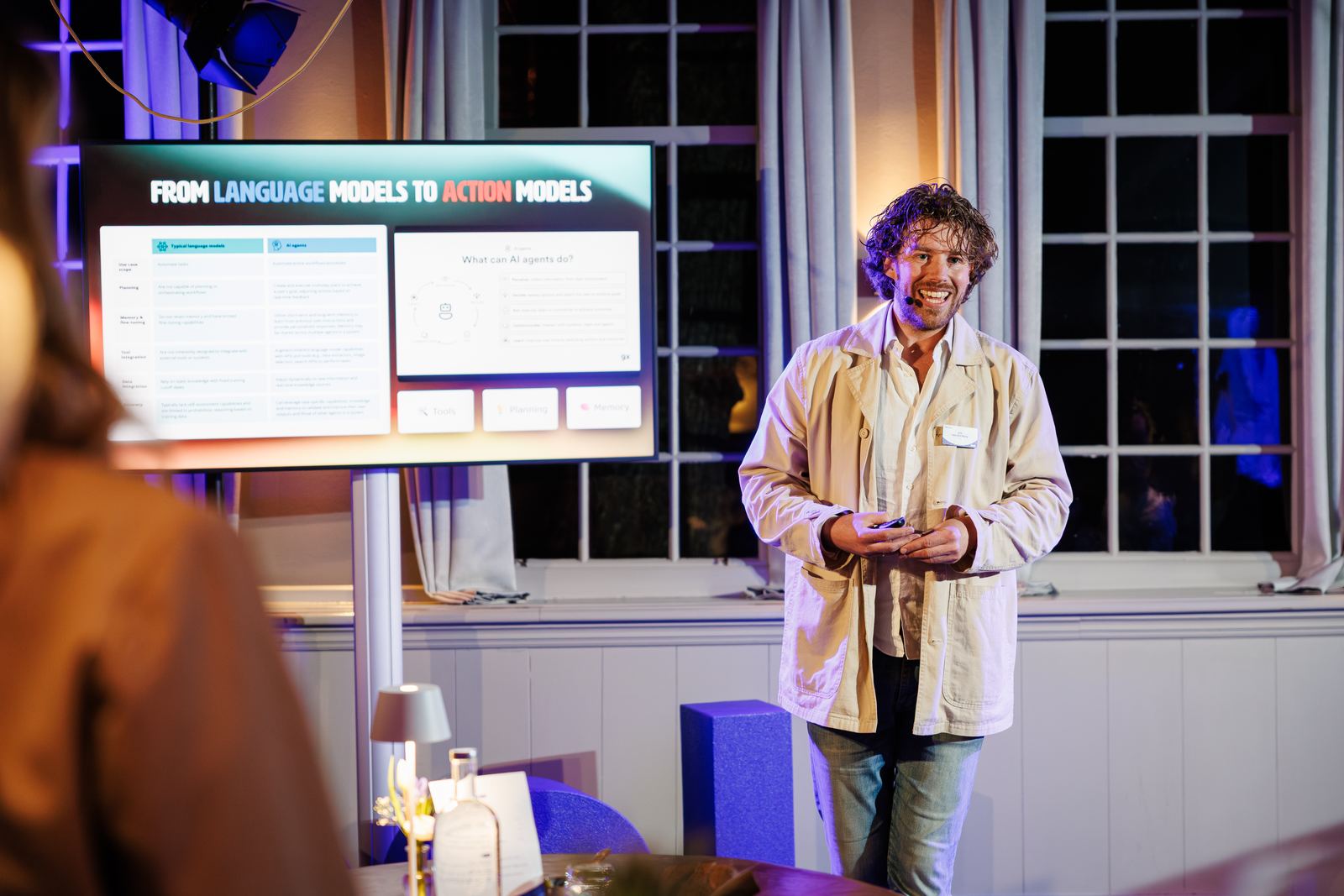
Job van den Berg is an AI keynote speaker, tech entrepreneur and author of five books on AI. He ships AI agents into production every week and delivers 150+ keynotes a year on AI agents and agentic commerce.
What are open weights and closed-source AI models? Discover the differences and the consequences for costs, privacy, data centers and the AI market.
On EditieNL I discussed whether AI could threaten humanity. About Anthropic researcher Evan Hubinger, agentic AI, the black box, and why we are building faster than we understand.
A simple AI video already costs about 4 litres of water and as much electricity as a 10-watt LED lamp burning for 42 hours. What happens with full films and commercials, and why digital is not automatically sustainable.
AI keeps getting better, yet workplace sentiment about AI is deteriorating. Research shows why adoption is as much a social challenge as a technological one: from the Matthew effect to psychological safety.